The three features that justify a smart charger
1. Off-peak scheduling. Many utilities charge substantially less for electricity overnight than during the late-afternoon peak. Shifting a full charge into that window is the single largest ongoing saving available to a home charger owner, and over a year it dwarfs the price difference between any two chargers on this page. The catch is that this is not a charger feature so much as a scheduling feature, and your car very likely has it. Check the car first. If it can set a departure time or a charging window, you do not need to pay a charger for the same function. Our cost-to-charge guide shows how to work out what the shift is actually worth on your own rate.
2. Load management.This is the feature that genuinely cannot be replicated by the car, and it is the reason to buy a smart charger even if you never open the app again. A load-managed charger watches the rest of the house — or a second charger on the same circuit — and reduces its own draw when everything else is running. That means you can sometimes fit a charger onto a panel that a load calculation says is full, avoiding a service upgrade that can cost more than the car’s first year of fuel savings. Our load management guide walks through when it works and when it does not.
3. Access control. If the charger is on a driveway, in a shared garage, or anywhere a neighbor could plug in, being able to require authorization is worth having. In a locked private garage it is irrelevant.
What does not justify the price
Energy dashboards are the headline feature in nearly every listing and the least useful in practice. You will look at the graph enthusiastically for two weeks and then never again, because there is nothing actionable in it — you already know the car charges overnight and you already know roughly what it costs. Firmware-updatable, Alexa-compatible, and “charging reports” are similar: real features that change nothing about your week.
How we ranked these five
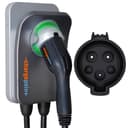
The ChargePoint Home Flex leadsbecause its app is the only one here with a genuinely long track record, and because it shares an account with ChargePoint’s public network. One honest note: the model we link is the NEMA 14-50 plug-in, a 40A unit — ChargePoint now sells the hardwired 16–50A version separately, and as of 20 September 2026 it is not listed on Amazon. For a smart-charger page that changes little, since 40A is the amount most homes should buy, but it does mean the Home Flex no longer covers an uncertain circuit; the Emporia below does. Our full Home Flex review covers what changed.
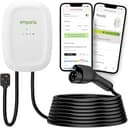
The Emporia is the value answer, and for a lot of buyers the better one. It is a 48A-capable charger with scheduling and load management at a price the premium brands do not approach, and it pairs with Emporia’s whole-home energy monitoring if you want the panel-level picture. The trade-off is a shorter service history. The Emporia vs ChargePoint comparison works through the decision in detail. Emporia also sells a Pro version, which is the same 48A charger with PowerSmart load management and a panel monitor bundled in — the one case on this page where paying for the app genuinely buys you a circuit you could not otherwise have.
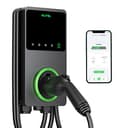
The Autel MaxiCharger wins on hardware, not software: 50A output, a NEMA 4 enclosure and a 25 ft cable. If the charger is going outside and you want the highest output available to a house, this is the one whose physical build is doing the most work. The app is competent rather than remarkable.
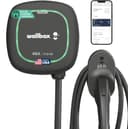
The Wallbox Pulsar Plus is the two-car answer.Power Sharing lets two Pulsar Plus units split a single circuit, which is the cleanest solution to a two-EV household short of a panel upgrade — and it is a capability the other units here do not have. It is also by far the smallest box on the wall. See the Autel vs Wallbox comparison for the two premium units head to head.
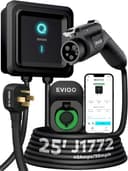
The EVIQO is the plug-in smart option.Every other charger here reaches its headline amperage only when hardwired. If you have a NEMA 14-50 outlet and no appetite for an electrician, this is a wall-mounted 40A station you fit yourself — and 40A is a full overnight charge for any car on the road.
Smart chargers and your panel
The single most expensive decision in home charging is not which charger you buy — it is what circuit you run to it. A 48A charger needs a 60A breaker, and if your panel cannot spare one, the upgrade will cost more than any charger on this page. Before you shortlist on features, get a load calculation and find out what your panel can actually give you. Our amps and circuits guide covers the 80% continuous-load rule and the breaker sizes; the installation cost guide covers what drives the bill.
Connectivity is a failure point too
It is worth saying the quiet part: every one of these chargers has a radio, a firmware image and a cloud account, and all three are things a dumb charger cannot fail at. Apps get redesigned, servers go down, and a charger that requires an account to start a session is a charger that can be inconvenienced by a company’s outage. Every unit here will charge without the app, but check that before you buy anything not on this list — some cheaper connected units genuinely will not. If none of the three features above apply to you, a plain 40A box is not a downgrade, and our no-Wi-Fi roundupranks the units with no radio at all — including two where EPA’s own certification record documents the absence rather than leaving you to infer it. Our 40A roundup and budget roundup cover that route.