What BMW publishes, and what it does not
This matters more than usual here, because the internet is full of onboard-charger numbers for BMWs that BMW does not state as hardware specifications. Here is the honest division.
What BMW publishes.The Flexible Fast Charger included with the car is “compatible with any 120V or 240V outlet”, and “the maximum power of 9.6kW is only attainable when equipped with the correct adapter” — the NEMA 14-50 or NEMA 6-50 adapter, on a 240V outlet. On that setup BMW publishes 0 to 100% in “under 12 hours”. The BMW Wallbox is published at 9.6 kW. For the i4 specifically, BMW states up to 9.6 kW on a 240V, 40A circuit with the NEMA 14-50 adapter.
What BMW does not publish on those pages.An onboard-charger rating for the car as a hardware figure. The 9.6 kW number is attached to BMW’s equipment, not to the vehicle, and none of the three BMW pages we read states a kW ceiling for the car itself. We are not going to convert an equipment rating into a vehicle specification and present it as BMW’s. The practical consequence is the same either way: 40 amps is the rate BMW builds its own home charging around.
The iX exception, and the cable it depends on
There is one BMW where a higher number is published, and it comes with a condition. BMW’s charge-time article for the 2026 iX gives 0 to 100% at 11 kW as approximately 9 hours 45 minutes on the xDrive45 and approximately 11 hours 15 minutes on the xDrive60 and M70, and says AC charging to a maximum of 22 kW is optional.
The condition is in the same article: BMW states you “will need a ‘22 kW BMW charging cable’” to charge at 11 kW. In other words the 11 kW rate is not something a US wall charger unlocks on its own — it is tied to BMW’s own cable, and in North America the single-phase supply in a house is a different arrangement from the three-phase supply those European 11 and 22 kW figures were written for.
So the honest reading is: if you have an iX, the 22 kW cable and an electrician who has confirmed a 60-amp circuit, pick five gets you 48 amps cheaply and you may see more than 9.6 kW. For everyone else — and for every i4, i5, X5 50e and 330e owner — the extra amps have nowhere to go. Our 40A versus 48A page works that trade-off in general, and our slow-charging guide explains why a bigger charger cannot push a car past its own ceiling.
Plug-in or hardwired, for a BMW specifically
A 40-amp charger needs a 50-amp circuit, because code sizes a continuous load at 125% of its draw. That is the same circuit a NEMA 14-50 receptacle sits on — and a NEMA 14-50 is exactly what BMW’s own Flexible Fast Charger adapter plugs into.
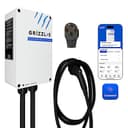
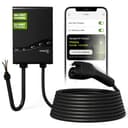
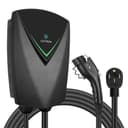
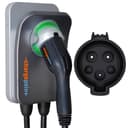
If an electrician has already put a 14-50 in your garage for the BMW cable, a plug-in charger is close to free to install: pick one, three or four all plug straight in. That is a real advantage over hardwiring, and it is why pick one leads this page rather than the more expensive hardwired units.
The counter-argument is the receptacle itself. Plug-in chargers have a reputation for nuisance-tripping GFCI protection, because NEC 210.8(A) requires GFCI for 125- to 250-volt garage receptacles and NEC 625.54 requires it for receptacles installed for EV charging, and the charger’s own ground-fault protection can conflict with an external GFCI. A hardwired charger is not subject to that receptacle requirement. Our plug-in versus hardwired guideworks through it, and if you do go plug-in, the receptacle grade matters — see NEMA 14-50 outlets.
Why no native-NACS charger is on this page
BMW announced access to Tesla’s Supercharger network, and that is a DC fast charging arrangement handled with an adapter at the station. It does not change the inlet on your car for home AC charging, which is J1772.
A charger with a factory NACS handle would need an adapter hanging off the connector every single night, which is a daily annoyance and an extra mechanical joint in the one place you least want one. Buy the connector your car actually has. If you are travelling and need the DC side, our NACS to CCS adapter page for BMW covers the adapter that belongs in the trunk rather than on the wall.
What we left out, and why
- Everything with a NACS handle. Wrong connector for a BMW at home, for the reason above.
- The BMW Wallbox itself. BMW publishes it at 9.6 kW, which is the same rate as pick one at a price BMW does not list on Amazon, so we cannot show you a live number for it or link it honestly. If your dealer quotes it as part of the car, compare that quote against pick one before accepting it.
- Level 1 charging as the recommendation.BMW’s own figure for the included cable on a 240V outlet is under 12 hours for a full charge; on 120V it is much longer. For a plug-in hybrid like the X5 50e or 330e that may genuinely be enough — see our plug-in hybrid charger page.
The short answer
Buy 40 amps. BMW’s own equipment is built around 9.6 kW, the i4 article names a 240V 40A circuit explicitly, and a 50-amp circuit with a NEMA 14-50 receptacle covers both a third-party charger and the cable that came with the car. Pick one is the best version of that for most BMW garages; pick two if you are hardwiring and the panel is tight. Save the 48-amp purchase for an iX with the 22 kW cable and a confirmed 60-amp circuit.
One buying note. Several of these brands sell direct as well as on Amazon and the prices are not always the same. We earn a commission on the links here and nothing on the direct ones, and we would still rather you paid less — check both.