How to verify compatibility before you buy
Work through these in order. Each one can independently stop the whole plan.
1. Look at your charge port.Ford, like the rest of the industry, is moving from CCS1 to native NACS ports. If your vehicle already has a NACS port, you do not need this adapter — you plug straight into a Supercharger, and the adapter you might want is the opposite direction, for CCS stations. Check the physical port before anything else.
2. Confirm Supercharger access in the FordPass app. Non-Tesla Supercharger access is account-based and vehicle-specific. Your VIN has to be recognized and the session initiated through the appropriate app. If your vehicle is not enrolled, no adapter fixes that.
3. Check whether Ford will supply the adapter.Automaker adapter programs have included free or subsidized units for existing owners on various timelines. It is worth five minutes on Ford’s owner site before spending money.
4. Check the site supports non-Tesla vehicles.Not every Supercharger location is open to other brands. The Tesla app and Ford’s navigation both flag which sites are, and it is worth confirming before you plan a route around one.
The Lightning’s particular problem: cable reach
This deserves its own section because it is the practical issue Ford owners actually hit, and almost nobody warns about it.
Supercharger cables are short. They were designed around a Tesla’s charge port, which sits at the rear-left corner of the vehicle, and around a stall layout where the car reverses in. The Mustang Mach-E and the F-150 Lightning both put their charge port at the front-left— the opposite end of a vehicle that is, in the Lightning’s case, considerably longer than a Model 3.
The consequences are real and worth planning around:
- You will often need to nose in rather than reverse in, which is the opposite of what the stall was designed for.
- At older sites with tight spacing, an F-150 Lightning may need to occupy two stalls to reach the cable at all. This is not popular at busy locations, and it is a reason to prefer newer pull-through sites where they exist.
- The adapter adds length to the connector assembly, which occasionally helps and occasionally makes an awkward angle worse.
- The whole assembly is heavy. A Supercharger cable plus a DC adapter puts real mass on the charge port. Where the geometry allows, support it rather than letting it hang.
None of this makes Supercharging impractical — it makes it something to plan rather than assume. Check the stall layout in the app before committing to a stop on a long drive.
What speed to actually expect
The Mach-E and Lightning are both 400V architecturevehicles, which is genuinely good news at a Supercharger. The cars that suffer most from adapter-based Supercharging are the 800V ones — Ioniq 5, EV6 and similar — because a 400V-native stall cannot feed their architecture at full rate. Ford owners largely avoid that problem. Our Ioniq 5 page explains the 800V issue if you are cross-shopping.
What still applies to every car, including yours:
- The charge curve tapers.Peak rate happens at a low state of charge and falls steeply as the battery fills. The last 20% takes as long as the first 60 — the arithmetic is in our how long to charge guide.
- Cold batteries charge slowly.Preconditioning — letting the car warm the pack en route by navigating to the charger — is the single largest thing you control. See our cold weather guide.
- Shared cabinets split power. Two cars on one cabinet means less for each.
- The adapter never increases your speed. It passes what the session negotiates. Its job is to not become the weak link.
Choosing between the three picks
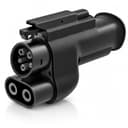
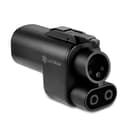
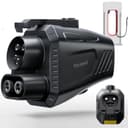
If Ford’s own route is unavailable, all three units above are rated for the full envelope of a Supercharger stall. The distinctions:
The A2Z Typhoon Pro publishes the strongest specification here and is the one we would buy for a vehicle that Superchargers regularly. Our full A2Z review covers what the 500A / 1000V rating actually buys you.
The Lectron is the most established brand in consumer EV adapters, which is worth something on a part you will hold in the rain. The Lectron vs A2Z comparison puts them directly against each other.
The FOCSPROD publishes an electronic interlock at a lower price. An interlock prevents the adapter being pulled off under load, which is the safety feature worth having on a DC part and one that cheaper units often omit.
The AC adapter is a different part
Worth separating, because it causes confusion. Everything on this page concerns DC fast chargingat a Supercharger. If what you want is to use a friend’s Tesla Wall Connector or a Destination Charger at a hotel, that is AC, and it needs a Tesla-to-J1772 adapter— a much cheaper and completely different product. Our AC vs DC guide explains why the two can never be the same part.