Build a kit, not a charger
The mistake road-trippers make is buying the highest-amperage unit and stopping there. A 40A portable is genuinely excellent — on a NEMA 14-50 it delivers the same power as a wall-mounted home charger — but 14-50 outlets are common in RV parks and workshops and uncommon almost everywhere else. If the only socket at your destination is a dryer outlet or a household plug, a 40A charger with no adapters is worth exactly what a 16A one is: nothing extra.
The kit that covers the most situations, in the order we would buy it:
- A 40A portable on a NEMA 14-50. Your headline capability, and it doubles as a home charger if you want it to.
- A NEMA 10-30 or 14-30 adapter. Dryer outlets are in almost every house you will stay in, and they roughly quadruple what a household socket gives you. Our NEMA adapter guide covers which one your host is likely to have.
- A 6-50 adapterif you visit workshops or farm buildings, where welder outlets are common — and unlike the dryer adapters, a 6-50 sits on a 50A circuit, so it gets you far closer to full output. Read the cord’s own instructions: the 6-50 adapters currently sold ask you to set the charger to 32A or less, which is still a third more than any dryer outlet allows.
- A Level 1 fallback for the nights when the only thing available is an ordinary socket.
The one rule you must not break:a plug adapter does not change the circuit behind the outlet. If you plug a 40A charger into a dryer outlet through an adapter, you must dial the charger down to 24A yourself. The adapter will not do it, the outlet will not stop you, and the breaker may take a while to object. Every charger worth carrying has an amperage setting — learn where it is before you leave.
How we ranked these five
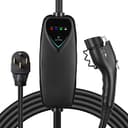
The Lectron 40A leadsbecause it is the most capable single purchase here. Forty amps on a 14-50 is a full charge overnight for essentially any car, and it packs down small enough to live permanently in the trunk. It is also the unit we recommend to renters, precisely because it works as a home charger too — see our full review.
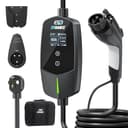
The EVDANCE 40A earns its place on the connector. It publishes an IP67-rated connector, and on a charger that gets thrown in a trunk, dragged across gravel and used in the rain outside a motel, sealing matters far more than it does on a unit bolted to a garage wall. Our EVDANCE review covers what the rating buys you.
The TLE LEVEL is the value 40A.Same core capability, published 25 ft cable, meaningfully less money. The honest caveat is a brand with no track record and a listing that does not name a certification body — verify that on the page before ordering, because it is the one specification we would never trade away.
The EVDANCE Level 1 & 2 is the flexibility pick, and for a lot of trips it is the smarter buy. It runs from an ordinary 120V socket or a 240V NEMA 6-20, it is ETL listed, and its 25 ft cable reaches outlets that a short cord cannot — which on a trip is a constant issue, because the socket is never where you would have put it. It will not fill a big battery overnight, but it will always work.
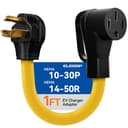
The ELEGRP 10-30 adapter is here because it is the highest-leverage $20 in the kit.It converts the three-prong dryer outlet found in older houses — useless to a 14-50 charger — into roughly 200 miles of overnight range. No charger upgrade comes close to that on a per-dollar basis.
Cable length is the spec that bites on a trip
At home you place the charger relative to the car. On a trip you take what you are given: an outlet in a garage while the car is on the drive, a socket inside a cabin with the car twenty feet away, a laundry room on the wrong side of a wall. A 16 ft cable that is fine at home is regularly inadequate away from it.
Buy the longest cable you can, and know the rules before improvising. Running a Level 2 charger through a household extension cord is genuinely dangerous — a continuous 40A draw through a cord not rated for it is the classic way to start a fire. If you need reach at Level 2, use a properly rated J1772 extension; our cables and extensions guide covers what “properly rated” means. At Level 1 from a household socket, a heavy-gauge outdoor-rated cord of the shortest workable length is the common approach, but read your charger’s manual — some manufacturers prohibit it outright.
What you will actually find, destination by destination
The kit list above is abstract until you know which outlet is waiting at the other end. Here is what turns up in practice, and what each one is worth in charging terms once the 80% continuous-load rule is applied.
- RV park or campground pedestal. The best case. Pedestals commonly carry a NEMA 14-50 on a 50A circuit — a full 40A, about 9.6 kW, roughly 30 miles of range per hour. Many pedestals also carry a 30A TT-30 RV socket, which is a different animal: it is 120V, not 240V, so it is worth far less than the number suggests. Call ahead and ask which they have.
- A friend or relative’s garage. Usually a household 5-15 socket — about 1.4 kW, 3 to 5 miles per hour. Overnight that is still 30 to 50 miles, which is often exactly enough to get to a fast charger the next morning. The upgrade is the laundry room: a 14-30 or 10-30 dryer outlet on a 30A circuit gives you 24A, about 5.8 kW, four times the household socket — provided you dial the charger down to 24A yourself.
- Hotels and motels. Assume nothing. Some have destination chargers, many have an exterior maintenance socket the front desk will not let you use, and a few have a 14-50 near a loading area. This is the one category where asking at booking time, not arrival time, changes the answer.
- Workshops, farm buildings and older garages. The place to hope for a NEMA 6-50 welder outlet. Unlike the dryer outlets it is on a 50A circuit, so the wall is not the constraint — the best-value adapter in the kit if your travel takes you to these buildings, subject to the 32A-or-less instruction the 6-50 cords themselves carry.
- Vacation rentals. Increasingly listed as an amenity, and increasingly wrong. “EV charging” in a listing can mean a wall charger, a 14-50 outlet, or an extension cord to a household socket. Ask for a photograph of the actual outlet before you rely on it.
Our NEMA outlet guide decodes the numbering so you can identify what you are looking at from a photo, and the NEMA adapter roundup covers the parts that bridge them.
If your car has a NACS port, add one more part
Nearly every portable charger sold today has a J1772 connector, including all five picks above. If you drive a Tesla, or one of the growing number of non-Tesla EVs now shipping with a factory NACS port, that cord will not plug into your car unaided — you need a J1772-to-NACS adapter, which is a small, cheap part and the single most important thing in the bag for those cars.
Two notes worth carrying. First, check the trunk before you buy one: cars sold with NACS ports have been shipping with charging adapters, and owners routinely buy a second. Second, a NACS port is not always the AC port — the 2026 Nissan Leaf, for example, uses NACS for DC fast charging and a separate J1772 socket for AC, so a J1772 portable plugs straight in with no adapter at all. The charging section of your manual settles it in a minute, and it is worth doing before a trip rather than in a stranger’s driveway. Our connector guide has photographs of each plug.
Asking to plug in
A practical note, because this is a social transaction as much as a technical one. Offer to pay. A full charge from empty is typically a few dollars to low double digits of electricity — our cost-to-charge calculatorgives you the number for your car and their rate, and being able to say “that’s about $8, here’s $20” changes the conversation entirely.
Ask before plugging into anything unusual. A household socket is a non-conversation; a dryer outlet means unplugging their dryer, and a 14-50 in an RV bay may be metered. And if a socket looks old, scorched or loose, do not use it. Level 1 charging is a sustained load on wiring that may be decades old, and a warm outlet plate is a stop signal.
What this does not replace
To be clear about the limits: none of this is DC fast charging. On a driving day you will still be planning stops around public fast chargers, and a portable charger sits in the trunk doing nothing. It earns its place at the ends of driving days, at destinations the network does not serve. Our AC vs DC guide explains why no portable unit will ever bridge that gap, and how long charging takes has the arithmetic for planning a trip.
Buying the kit for somebody else
This kit happens to make an unusually good present, because it is several inexpensive items that add up to something the recipient could not do before, and because nobody buys the outlet adapters for themselves until the moment they need one. Our gifts for EV road trippers guide picks the same kit apart for a gift buyer, including what to confirm about the car before ordering each part.