Build a kit, not a charger
The logic behind this whole page is worth spelling out, because it is the opposite of how the category is usually sold. Road-trip charging happens in three places, and only one of them needs hardware.
On the highway, the driver uses public DC fast chargers. Nothing in a trunk helps there; what matters is which network their car can use, which is an adapter question rather than a charger question. At a hotel, there may be a J1772 station, a Tesla Destination Charger, or nothing. At the destination— a rented house, a relative’s driveway, a campground, a workshop — there is almost always an outlet, and the entire question is whether the car can use it.
The kit answers the second and third cases, cheaply. Our road-trip charging guide works through the same problem destination by destination, and is the page to read if the recipient wants to go deeper than a present.
The trunk charger
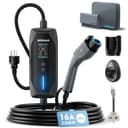
A portable Level 1 and Level 2 unit is the anchor of the kit. The point is not speed — it is that one small box handles both a 120V household outlet and a 240V outlet, so it can use whatever the destination happens to have. Plugged into a normal wall socket it trickles; plugged into a dryer or RV outlet through the right adapter it delivers a real overnight charge.
Two things to look for as a gifter. The first is certification: UL or ETL testing, named on the listing. These units draw current unattended for hours in receptacles the owner did not install and cannot inspect, which is the exact scenario that testing exists for. The second is cable length. At home, a short cable is an inconvenience. At a rental, where the outlet is in a garage and the car is on a driveway, a short cable is the difference between charging and not. Our portable charger roundup compares the options on both, and our certification guide explains the marks.
What to check before ordering: the charge port shape. A portable charger with a J1772 connector fits almost every non-Tesla EV; a NACS car needs either a NACS unit or the adapter it came with. Our connector guide describes both ports.
The adapters: three plug shapes that cover most destinations
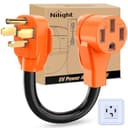
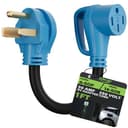
This is the part almost nobody buys for themselves, because you only learn you needed it once you are standing in a strange garage looking at an outlet that does not match. Each adapter is a short cord with a different male plug on one end and a NEMA 14-50 socket on the other, so a 14-50 charger can use an outlet it was not built for.
The three worth owning cover the outlets that actually turn up. A NEMA 14-30 or 10-30 plug is the electric clothes dryer — present in a very large share of rented houses and cabins, often in a garage or a utility room within reach of a driveway. A NEMA 6-50 is the welder outlet, which turns up in workshops, barns, farm buildings and some campgrounds. A NEMA 14-50 needs no adapter at all and is the RV pedestal at most campgrounds, which is the single best-kept secret in EV travel: a campground RV hookup is a 240V 50A outlet, and a lot of them will rent you a site for the night.
The condition on all of this is amperage, and it is not optional. A dryer circuit is smaller than a 14-50 circuit, so the charger must be set down to a safe current for it. The adapter is a passive cord and will not limit anything on its own. Chargers with an adjustable current setting are the ones that make this work; a fixed-output unit must not be pushed onto an undersized circuit. Our NEMA adapter roundup lists the limits per plug, and our outlet types guide shows what each shape is rated for.
What to check before ordering: that their charger has an adjustable amperage setting, and ideally which outlets they keep encountering. Two adapters and a card explaining the amp rule is a better present than four adapters and no explanation.
Hotel parking: the adapter that doubles the options
For a non-Tesla driver, a Tesla-to-J1772 adapter turns Tesla’s AC Destination Chargers into usable overnight charging. Those units are bolted to the walls of an enormous number of hotels, inns, restaurants and wineries, and on a road trip they are frequently free and frequently empty while the one public J1772 station in town has a queue.
It is an AC adapter. It does not enable Supercharging and nothing that looks like it does. Our Tesla-to-J1772 roundup compares the options, and our public charging guide explains how the networks fit together.
The bigger gift: a DC fast-charging adapter
This is the present that changes a long drive rather than a long stay, and it is the one item here you should not buy blind.
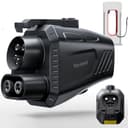
A NACS-to-CCS adapter lets a CCS car use Tesla Superchargers, which on many routes is the densest and most reliable fast-charging network available. A CCS-to-NACS adapter does the reverse for a Tesla using other networks. Either can genuinely remove the anxious part of a route.
The catch is that support depends on the vehicle’s own hardware and software and varies by model and model year, and an unsupported car does not charge slowly — it fails the handshake and does not charge. Our NACS-to-CCS roundup and CCS-to-Tesla roundup set out what to confirm, and we publish per-vehicle pages for the common cases — a Hyundai Ioniq 5, a Rivian, a Ford and others. If you cannot confirm the model and year without giving the game away, give something else and let them choose this one.
Why the adapters are the valuable part
It is worth understanding the arithmetic, because it is the reason a twenty-dollar cord is a better present than it looks. All three of these numbers come from the same portable charger; only the outlet changes.
On a 120V household socket, a portable charger is doing a few miles of range per hour. Over a twelve-hour night at a cabin that is a partial recovery at best, and on a trip where you drove several hundred miles to get there, it does not restore the day you just used.
On a 240V dryer circuit through the right adapter, the same unit is working at several times that rate — enough that a night plugged in covers a normal day of driving and then some. On a NEMA 14-50 campground pedestal, a 40A-capable charger is doing a full home-charger job on somebody else’s wiring.
The charger did not change. The outlet did. That is the entire argument for gifting the adapters alongside the charger rather than assuming they will buy them later, and it is why our charging time guide and outlet types guide are the two pages to hand over with the box.
If they drive a NACS car, add one part
Most portable chargers sold in North America have a J1772 connector, because that is what the majority of cars use. A Tesla or other NACS-port car can still use one — through the J1772 adapter that came with the car, which is precisely the small object that gets left behind at charging stations.
So for a NACS driver, a travel kit built on a J1772 portable charger quietly depends on an adapter they own exactly one of. Either add a spare adapter to the gift, which is cheap and is a good present in its own right, or buy a NACS-connector portable instead so the kit is self-contained. Our portable chargers for Tesla page covers the second route and our gifts for Tesla owners guide covers the first.
Winter, if the trip is in December
Worth knowing if you are buying for a Christmas road trip rather than a summer one: cold changes the arithmetic. A cold battery accepts charge more slowly and the car spends energy heating itself and the cabin, so both range and charging speed fall in genuinely noticeable amounts. That makes destination charging — the outlet at the cabin, reached with the kit on this page — more valuable in winter rather than less, because a slow overnight charge in the cold beats arriving at a fast charger with a cold pack. Our cold weather charging guide covers what actually helps.
The part of the gift that is free
Whatever you buy, the thing that makes it work is one phone call the recipient probably will not think to make. When booking a cabin, a campground or a rental, ask two questions: is there a 240V outlet anywhere I could reach from the parking space, and what shape is it? A photograph of the receptacle answers both, and almost every host will send one.
That single exchange converts a bag of adapters into a plan, and it is why we suggest giving this kit with a note rather than silently. It also prevents the failure mode nobody anticipates: an outlet that exists, is the right shape, and is forty feet from where the car can actually park.
What not to buy
A long extension cord from a hardware store. An ordinary household extension cord is not built for a continuous EV load and is a genuine fire risk in this application. If reach is the problem, the answer is a properly rated J1772 extension matched to the charger’s amperage, not a domestic cord.
A DC adapter for a car you have not checked. Covered above, and worth repeating because it is the most expensive mistake available on this page.
Anything sold as making charging faster. On a road trip the limit is the station, the circuit and the car’s own hardware. No accessory raises it, and our Level 2 vs DC fast charging guide explains where the ceiling comes from.
A subscription to a charging network. Tempting as a gift card alternative, but which network is useful depends entirely on their routes and their car’s connector, and several are free to join anyway. The kit works everywhere; a membership works in one place.