Which of these is right depends on one thing
The charge port. A J1772 port is the larger one, round across the top and flattened along the bottom, and it is what almost every non-Tesla EV in North America uses for AC charging. A NACS port — the connector Tesla designed, now the SAE J3400 standard and increasingly fitted to other brands too — is noticeably smaller with a flat top.
You can identify either from a photograph. Our connector guide describes both in detail. Once you know which one it is, this page collapses to two or three candidates rather than five, and one pick — the enclosure — does not care at all.
The portable charger: the safe choice at this price
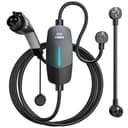
If you take one thing from this page, take this: a portable Level 1 and Level 2 charger is the highest-confidence gift in the band. It fits any car with a J1772 port, it needs no installation, no permission and no decision about anyone’s electrical panel, and it works on both a 120V household outlet and a 240V one — slowly on the first, properly on the second.
What it actually unlocks is charging in places the recipient currently cannot charge at all: a relative’s garage, a holiday rental, a workplace with an outdoor socket, a campground pedestal. Our portable charger roundup compares the category, and our road-trip guide shows how a portable plus two short outlet adapters becomes a travel kit.
Two things to look for. Certification— UL or ETL testing named on the listing — matters more here than on almost anything else, because a portable unit draws current unattended for hours in receptacles nobody has inspected; our certification guide explains the marks and why a charger that names no laboratory is not simply a cheaper version of one that does. Cable length matters more than people expect: at a rental, where the outlet is in the garage and the car is on the driveway, a short cord is the difference between charging and not.
What to check before ordering: that the port is J1772. A NACS car can use a J1772 portable through the adapter it came with, but if you want the no-adapter version, buy a NACS unit instead — our portable chargers for Tesla page covers those.
The three adapter directions, in plain terms
The reason adapters confuse gift buyers is that there are three separate journeys and they all get called “an EV adapter”. Here they are, once, clearly.
1. Non-Tesla car, Tesla AC charger — the safe one
A Tesla-to-J1772 adapter lets a car with a J1772 port plug into Tesla’s AC Destination Chargers: the wall units at hotels, inns, restaurants and wineries, of which there are an enormous number and which are frequently empty while the one public station in town has a queue.
This is an AC adapter and it needs no compatibility check at all — if the car has a J1772 port, it works. That makes it the best gift on this page for a non-Tesla driver, and the only adapter here you can buy without investigating their car. It does not enable Supercharging, and you should distrust any listing implying it does. Our Tesla-to-J1772 roundup compares the options.
2. Tesla, non-Tesla DC fast charger — check the car
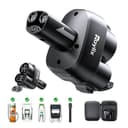
A CCS-to-NACS adapter lets a Tesla use the DC fast chargers run by other networks, which matters wherever Supercharger coverage is thin or busy. Some are two-in-one units that also handle J1772 AC charging, which makes them a single adapter covering all three charging levels — a tidier present than two separate pucks.
Support depends on the vehicle and, on some cars, on software version. Our CCS-to-Tesla roundup sets out what to confirm before buying.
3. CCS car, Tesla Supercharger — check the car most carefully
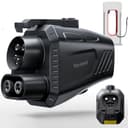
A NACS-to-CCS adapter is the one that opens the Supercharger network to a non-Tesla car, and it is the most genuinely route-changing item on this page. It is also the one with the most per-vehicle variation: support differs by manufacturer, model and model year, and in several cases by which Supercharger generation the driver pulls up to.
We publish per-vehicle pages precisely because of this — there are separate write-ups for a Hyundai Ioniq 5, a Kia EV6, a Rivian, a Ford, a Chevy and others. Read the page for their car before you buy, and if you cannot establish the model year, choose differently. Our NACS-to-CCS roundup and Supercharger access guide cover the landscape.
The enclosure: for a charger that already lives outside
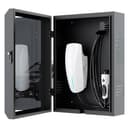
The odd pick, and a good one if it applies. A charger mounted on an exterior wall is fighting something most people get wrong: the enemy is not rain, which the unit’s own rating handles, but ultraviolet light, which embrittles plastic and degrades cable jackets over years of afternoons. A box or a padded cover shades the unit and, in the lockable versions, also stops someone walking off with the connector.
It is completely car-agnostic, so no port check is needed. What it does need is the charger’s dimensions, because an enclosure that does not fit is a return. Our charger covers and enclosures roundup covers what to measure, and our outdoor charger roundup explains the enclosure ratings on the chargers themselves.
What to check before ordering: the make and model of their wall charger, and whether it is mounted somewhere that gets direct sun. If the charger is in a garage, skip this one entirely — it solves nothing indoors.
Two things to confirm on any listing in this band
The testing laboratory. Every product card on this site prints “Not published” where a manufacturer declines to state a figure, and certification is the field where that gap matters most. UL and ETL are both Nationally Recognized Testing Laboratories and neither is better than the other; what matters is that a named lab tested the product at all. A listing that names none is telling you something.
What the amperage figure refers to. On an adapter, a large number like “500A” describes what the contacts are rated to carry, not what the car will draw — the car and the station set that. On a portable charger, the amperage is the real output ceiling, and it is capped further by the circuit it is plugged into. Neither number means the recipient’s car will charge faster than its own onboard hardware allows, which is the ceiling our charging time guide explains.
If the recipient drives a plug-in hybrid
One case where spending less is the better gift, not the cheaper one. A plug-in hybrid has a small battery and, more importantly, a small onboard charger — frequently around 3.3 kW, which is roughly 14 amps. A 16A portable charger saturates that completely. A higher-amperage unit delivers exactly the same overnight result, on a more expensive circuit, for more money.
So for a PHEV owner, do not buy up this list. Buy the modest portable charger, and spend the difference on a second one to leave at work, or on the cable management from our under $50 guide. Our plug-in hybrid charging guide sets out why almost every amperage argument on this site inverts for a PHEV.
If several people are going in together
A group gift in this category has an obvious-looking destination and a better one. The obvious destination is a Level 2 wall charger, which pushes past this budget and straight into the problem the rest of this site exists to solve: the right unit depends on the recipient’s panel, circuit and parking, so a group buying one without them is buying a return.
The better destination is the installation. It is the larger number on most jobs, it is the part nobody enjoys paying for, and a contribution toward it cannot be the wrong model, the wrong amperage or the wrong connector. If you want something physical to hand over on the day, pair the contribution with the industrial-grade NEMA 14-50 receptacle the electrician will need, which is a real part of the job and costs a fraction of the total. Our installation cost guide covers what a realistic quote looks like and why two houses on the same street can differ so much.
What this budget still does not buy
A Level 2 wall charger worth installing. The certified units we would put on a wall start above this band, and more importantly the choice is not a gift decision: it depends on their electrical panel, the circuit an electrician can run, where the car parks and whether they are allowed to mount hardware there. The install commonly costs more than the charger. If you want to spend at that level, contribute to the installation — it is worth more and it cannot be the wrong model.
A high-amperage portable. The 32A and 40A travel units are a real step up and sit above this band. Our portable roundup covers them if the budget is flexible.
A long, properly rated extension cable. Worth owning, above this band once the amperage rating is right, and never to be substituted with a household extension cord. Our cables and extensions guide explains why.
If you would rather spend less, or more
Below this band, the value is in cable management and a NEMA outlet adapter — our under $50 guide covers it, and honestly the ratio of usefulness to money is higher there than here. Above it, the honest advice is to stop buying hardware and start buying the install. And if you are shopping by recipient rather than by budget, we have pages for Tesla owners, for someone who just bought their first EV, and for drivers who take road trips. If the timing is flexible, our Black Friday page shows which of these is actually reduced today.