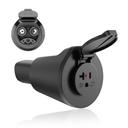
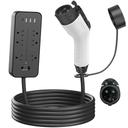
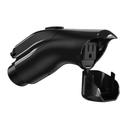
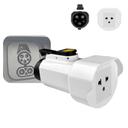
The four, side by side
Read from the same registry entries as the write-ups above. The connector column is the only one that can disqualify a purchase outright, so read it first; the italic cells are figures the seller does not publish.
| Product | Connector | Max output | Max power | Cable | Install | Warranty | Price |
|---|
| LZSTEC NACS V2L Adapter (20A / 2.4 kW) | NACS inlet → household outlet | 20 A | 2.4 kW | Not published | Plug-on adapter (vehicle charge port) | Not published | |
|---|
| HITRENDS J1772 V2L Adapter (1,250 W, 6 outlets) | J1772 inlet → 120V outlets | Not published | 1.25 kW | 14.7 ft | Plug-on adapter (vehicle charge port) | Not published | |
|---|
| HTSHS Portable V2L Adapter | J1772 inlet → household outlet | Not published | Not published | Not published | Plug-on adapter (vehicle charge port) | Not published | |
|---|
| EVqiaoyi J1772 Type 1 V2L Adapter (2022-2024 cars) | J1772 (Type 1) inlet → household outlet | Not published | Not published | Not published | Plug-on adapter (vehicle charge port) | Not published | |
|---|
What V2L actually is, and what it will run
Vehicle-to-load means drawing AC power outof the traction battery through the charge port. The adapter is a passive plug that tells the car to energize the port and presents a household outlet on the other end. The car does the work: it inverts the pack’s DC to 120 volts AC and decides how much it will give you.
That ceiling is the number that matters, and it is low compared with charging. The most generous figure published by any adapter here is 20 A / 2.4 kW, and the power-strip unit publishes 1,250 W. For context, a Level 2 charger on the same car moves 7–11 kW the other way. So the realistic shopping list is a fridge, lights, a laptop and phone charging, a coffee maker, a small pump, power tools, an e-bike charger, a projector at a campsite. The things to leave out are resistive heating loads and anything with a large motor — a space heater, a window air conditioner, a welder, an electric kettle plus a microwave at the same time. Two of those simultaneously is how you find the limit.
One honest point about using your car as a generator: the energy comes out of the traction battery, and a large draw over a long outage leaves you with less range than you expected. That is a trade worth making in a blackout and a bad habit the rest of the time. If what you actually want is to charge the car faster rather than discharge it, our home charger roundup is the page you want.
Which cars have it, and at what rating
V2L is not a universal EV feature and the published ratings differ by maker, so the sensible move is to find your own car’s figure rather than the adapter’s. Two we can quote directly. Kia names V2L capability on its own EV6 product material, which is why that car appears on nearly every fitment list in this category. Nissanpublishes a specific number for the redesigned Leaf — 1,500 watts of vehicle-to-load, and its own press material adds that it “requires adapter for exterior J1772 port”, which is precisely the part this page is about. Hyundai’s Ioniq 5 and 6 are the cars the category was built around, and Genesis models appear on one fitment list here.
Two consequences worth drawing out. First, the car’s rating caps you, not the adapter’s: a 20 A / 2.4 kW adapter on a vehicle that publishes 1,500 W gives you 1,500 W. Second, a J1772 port on a 2026 car does not mean a J1772 V2L adapter is right— some cars have moved their AC charging inlet to NACS while keeping a separate port arrangement, so check the socket you will actually plug the adapter into rather than assuming from the model year alone.
What it costs you in range
Worth doing the arithmetic before a camping trip, because the answer is reassuring. Drawing the full 2.4 kW for eight hours is about 19 kWh. On a car achieving roughly 3 miles per kWh that is somewhere near 55 to 60 miles of range — our arithmetic from the adapter’s own published figure, not a manufacturer claim. A fridge and some lights overnight is a fraction of that. A space heater for a weekend is not, and this is where people get caught: the cars let you set a floor below which discharge stops, and setting it before you leave is the difference between a useful weekend and a tow. If you want the cost of the energy rather than the range, our cost-to-charge guide runs the same kWh figure against your own electricity rate.
V2L against a portable power station
An honest comparison, since the two compete for the same money. A power station with a comparable usable capacity costs several times what any adapter here does, weighs tens of pounds and has to be charged in advance — but it can be carried away from the car, runs silently indoors and does not touch your driving range. The adapter costs tens of dollars, weighs almost nothing, needs no charging and draws on a battery measured in tens of kilowatt-hours — but it only works where the car is parked, and every kilowatt-hour is a mile you do not drive. If the use case is outages at home and trips in the car, V2L is extraordinary value. If it is a worksite with no vehicle nearby, it is the wrong tool.
How we judged them
1. Inlet generation, stated on the listing.The single criterion that can make an adapter useless. We rated a listing higher for printing its fitment years or naming the current model generation, and lower for leaving it to the buyer to work out. The EVqiaoyi is the clearest here (“ONLY for 2022-2024”); the LZSTEC names the current Kia and Hyundai generation outright.
2. A published output.Most listings in this category publish no current and no wattage at all, which makes it impossible to know what you can plug in. Two of the four here publish something: 20 A / 2.4 kW on the LZSTEC and 1,250 W on the HITRENDS. We will not fill that gap with arithmetic dressed up as a spec, so the other two read “Not published” and are ranked accordingly.
3. How the adapter behaves under load.This is a connector carrying household current out of a 400-volt-class battery pack. The LZSTEC is the only listing that publishes a locking and release behavior (“vehicle-controlled locking”, “automatic release”) and a thermal limit (85 °C). Whether every rival has equivalent protection we cannot say — only that they do not publish it.
4. Outlets and cable. If the adapter hangs off the charge port with one socket on it, every device you plug in has to reach the side of the car. A published cable length and multiple outlets genuinely change what the thing is useful for, which is why the HITRENDS earns its slot despite publishing no amperage.
What we did not rate. Certification, because not one listing in this category names a testing lab. On a charger we treat that as disqualifying; here there is nothing to compare, so we say it plainly instead of pretending one is safer than another. That absence is also the reason this page is shorter on picks than our other adapter roundups — we only list units that were verifiably in stock with the brand named in the listing title, and several otherwise-plausible options published no brand at all.
The picks in detail
The LZSTEC NACS V2L leads because of what it tells you.Up to 20 A and 2.4 kW, plug and play, vehicle-controlled locking, automatic release, 85 °C thermal protection, and named fitment for Kia EV3/5/6/9 and Hyundai Ioniq 5/6/9. In a category where the typical listing publishes a car list and nothing else, that is a different level of disclosure. The cons are real: it is the most expensive of the four, it publishes no outlet configuration, cable length or warranty term, and it is NACS inlet only— it will not fit a 2022–2024 Ioniq 5 or EV6.
The HITRENDS J1772 V2L is the one that is really a power station.It publishes a 1,250 W six-outlet strip with USB on a 14.7 ft cable, and names the widest fitment list here: Hyundai Ioniq 5 and 6, Kia EV6 and Niro EV, and Genesis GV60, GV70 and GV80. If the point of V2L is a campsite with four things plugged in, this shape does it without a separate extension lead. The cons: J1772 inlet only, no amperage or certification body published, no warranty term, and stock was thin when we checked (“Only 7 left”) — confirm availability before planning a trip around it.
The HTSHS Portable V2L is the plain middle option. A J1772-inlet adapter for an Ioniq 5, Ioniq 6 or EV6 at roughly half the price of the feature-rich units, in stock when we looked, with the brand named in the title. Be clear about what you are accepting: this is the thinnest spec sheet in the category— no amperage, no wattage, no outlet type, no cable length, no warranty term. It is here because it is a verified-live, brand-named option at a fair price, not because it out-documents anything.
The EVqiaoyi J1772 Type 1 V2L is the budget pick and the most honest listing in the group.It is the cheapest V2L adapter we found with a brand in the title, and it states its limit out loud: 2022–2024 Hyundai Ioniq 5 and Ioniq 6 and Kia EV3/6/9 only. In a category where fitment is the thing buyers get wrong, printing the model years is worth more than another bullet point. The cons are the same as the HTSHS — nothing published beyond compatibility — plus a brand with no track record we can verify.
Before you buy
Check your car supports V2L, and check the inlet.Both are model-year questions, and both are answered in your owner’s manual rather than by an adapter listing. Hyundai and Kia have shipped V2L across several generations with two different inlets; Genesis models appear on one of the fitment lists here. If your EV is from another maker, V2L support is the exception rather than the rule.
Expect to supply your own extension.Only one pick here publishes a cable length. If the adapter sits at the charge port with a single outlet, a decent outdoor-rated extension lead is the difference between useful and awkward — and unlike extending a charging circuit, which we argue against, an extension on a 120-volt V2L outlet is ordinary household practice at ordinary household current.
Do not confuse this with charging adapters. A V2L adapter takes power out; a J1772-to-NACS or NACS-to-J1772 adapter lets you take power in. They fit the same port and do opposite jobs. Our adapter roundup covers the charging direction, and the best adapters under $50 covers the cheap end of it. If your car has a NACS inlet and you want to charge at ordinary J1772 stations, that is a J1772-to-NACS adapter— a different part entirely.