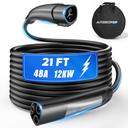
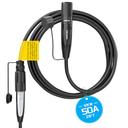
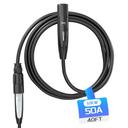
The four, side by side
Read from the same registry entries as the write-ups above. The two columns that decide this purchase are the amperage and the length — and the italic cells are what the sellers do not publish.
| Product | Connector | Max output | Max power | Cable | Weather rating | Warranty | Price |
|---|
| Autodecor 1Up NACS Extension Cable (48A, 21 ft) | NACS (Tesla) | 48 A | 11.5 kW | 21 ft | IP66 when connected (per the listing) | Not published | |
|---|
| bokman NACS Extension Cord for Tesla (50A, 21 ft) | NACS (Tesla) | 50 A | 12 kW | 21 ft | Not published | Not published | |
|---|
| EVDANCE NACS Extension Cord (50A, 21 ft, 12 kW) | NACS (Tesla) | 50 A | 12 kW | 21 ft | Not published | Not published | |
|---|
| EVDANCE NACS Extension Cord (50A, 40 ft, 12 kW) | NACS (Tesla) | 50 A | 12 kW | 40 ft | Not published | Not published | |
|---|
The four criteria, in the order that matters
1. Amperage, matched to the charger it extends — not to the car.A Tesla Wall Connector delivers up to 48 A; a Mobile Connector is capped at 32 A by the NEMA adapter on its end. So a 48 A extension covers any home Tesla setup, and a 50 A one has headroom to spare. What you must not do is put a lower-rated extension in front of a higher-output charger: the extension becomes the weakest link in a circuit that runs at full current for hours at a time. All four here publish 48 A or 50 A, which is why all four are listed.
2. What the listing says it does NOT work with.This is the criterion buyers skip and then return the product over. Every one of these is AC only — no Supercharger, ever. Beyond that, the exclusions differ: EVDANCE’s 21 ft cable names Wall, Destination and Mobile Connectors, while its 40 ft cable states it is not for Tesla Mobile Connectors. If your charging setup is the cordset that lives in the trunk, that single line rules out the longest cable on this page. Read the exclusion before you read the price.
3. Length against the actual problem.Twenty-one feet is the standard here and it solves the common case: a Wall Connector mounted on the wrong wall of a one-car garage, or a charge port on the far side of the car. Forty feet solves a different problem — a detached garage, a driveway on the other side of the house, a shared parking space. It is also heavy, awkward to coil, and twice the price. Measure the real path, including slack so the cable is not under tension, before deciding you need the long one. Our long-cable charger roundupis worth reading first: if you have not bought the charger yet, 25 ft of attached cable beats 21 ft of extension.
4. Whether a lab is named.One listing of the four claims a UL certification; the other three name no testing body at all. We treat that as a real differentiator rather than a tiebreaker, because this is a connection carrying 48 amps continuously, outdoors, in a part that gets coiled, dragged and stepped on. It is also why we did not pad this page out with the unbranded listings in the same search — several published neither a brand nor a lab.
What we deliberately left out
DC extension cables. There are listings that advertise a short NACS extension for DC fast charging at several hundred amps. We are not recommending one: the money is large, the engineering claim is extraordinary, and nothing about a Supercharger session has margin for an extra connection. Unbranded extensions. A listing with no brand in the title cannot be matched to a manufacturer, which is the minimum we need before we put a product in the registry. Adapters sold as extensions.A J1772-to-NACS adapter adds no length at all — that is a different part.
Measure before you choose a length
Two minutes with a tape measure decides between the 21 ft and 40 ft cables, and the mistake people make is measuring in a straight line. Park the car where it actually parks. Run the tape from the charger’s connector, down the wall to the floor, along the floor to the car, around the body to the charge port, and then add the slack you need to plug in without the cable going taut — a cable under tension pulls on both couplings every single night. Subtract the charger’s own cable length from that total: Tesla publishes 24 ft on the Wall Connector and 20 ft on the Mobile Connector. What is left over is the extension you actually need, and it is usually less than people assume.
Three things that change the answer. Which side the charge port is on— a port on the far side of the car can add fifteen feet to the path on its own. Whether you back in, which can halve the requirement or double it. And whether a second car shares the space, because a cable routed around another vehicle is both longer and a trip hazard. If the honest answer is that nothing under 40 ft works, treat that as a signal to price a second circuit nearer the car before buying the long cable.
Three ways to avoid needing one at all
Mount the charger where the car stops. Obvious, routinely skipped, and free if the charger is not installed yet. Buy a charger with a longer attached cable.Twenty-five feet is the practical market maximum and several units publish it — that is one continuous, factory-made cable rather than two with a coupling in the middle, which is strictly better. Move the outlet, not the cable. On a plug-in install, relocating a NEMA 14-50 receptacle is usually cheaper than people expect and permanently removes the problem; our installation cost guide covers what drives that quote.
How to keep one healthy
An extension adds two connections to a circuit that runs at 40-plus amps for hours at a stretch, and connections are where heat appears. Four habits, none of which cost anything. Keep the coupling off the groundand out of standing water and snow when it is connected — a holster or hook does this. Never run two extensions in series, and never add an adapter to the chain. Do not let a tire cross the cable repeatedly; if the route has to cross a driveway, that is what cable ramps are for. Feel the housings after an hour of charging, every few weeks for the first couple of months: warm is normal, hot is not, and discoloration at a contact means retire the cable rather than clean it. Our troubleshooting guide covers what to check when a session stops unexpectedly, which an ageing coupling can cause.
The picks in detail
The Autodecor 1Up 48A leads on the only safety claim anyone makes.Its listing publishes a UL certification, silver-plated contacts, IP66 when connected, 21 ft at 48 A, and compatibility with Level 1 and Level 2 Mobile Connectors and wall chargers across Model 3, Y, S, X and Cybertruck. At our last check it was also the cheapest branded option in the group, which is the opposite of the usual pattern. The cons: the listing publishes no conductor gauge and no warranty term, the brand is little known with no track record we can verify, and 48 A is the ceiling rather than 50 A like the others.
The bokman 50A has the highest published rating hereand comes from a brand the site already covers on portable chargers, so it is not a single-listing seller. Fifty amps at 240 volts over 21 ft, with the listing naming both Wall Connector and Mobile Charger use across Model 3, Y, S, X and Cybertruck. The cons are all omissions: no certification body, no conductor gauge, no ingress rating and no warranty term published — and it sits mid-priced in a group whose cheapest option claims more. See our dual-voltage roundup for the other bokman product we cover, and the honest caveat we apply there too.
The EVDANCE 21 ft is the one whose limits are easiest to read.Fifty amps, 240 volts, 12 kW, 21 ft, named for Tesla Wall, Destination andMobile Connectors, with “not for Tesla Superchargers” printed in the title rather than buried. If you are going to be lending this to someone else in the household, a product that states its own boundary is worth something. The cons: it is the dearest 21 ft option here, and it publishes no certification body, conductor gauge, ingress rating or warranty term. We cover this brand’s wider range, and where rivals beat it, on EVDANCE alternatives.
The EVDANCE 40 ft exists for one reason: reach.Double the length of everything else at the same published 50 A, 240 V and 12 kW, named for Tesla Wall and Destination chargers. Two cons that are genuinely disqualifying for some buyers, both from the listing itself: it is not for Tesla Mobile Connectors, and like everything here not for Superchargers. Add the practical ones — it is the most expensive pick on the page, and 40 ft of 50-amp cable is heavy to handle and store. If the distance is really this bad, price a second circuit closer to the car first; our detached-garage guide covers what that involves.
If your car is not a Tesla
These are NACS cables, which means a Tesla or another car with a Tesla-style port. For a J1772 car the equivalent part is a J1772 extension, and we cover those — including a 40 ft, 40 A option and a 32 A one — on our charging cables and extensions roundup. Do not try to solve the problem with an adapter in the chain: stacking a NACS-to-J1772 adapter onto an extension onto a charger is three connections where there should be one, and each is a place for heat to build.
One last practical note that applies whichever cable you buy. Keep the coupling off the floor and out of standing water when it is connected, do not run the cable where a tire will cross it repeatedly, and check the connector housings for heat or discoloration every few weeks for the first couple of months — warmth at a coupling under load is the early sign of a connection that needs retiring. A holster and a hook cost twenty dollars between them and are the cheapest insurance on the whole setup.