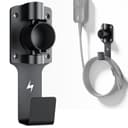
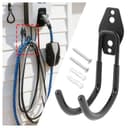
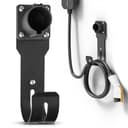
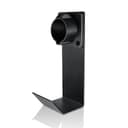
Why a cable on the floor is a real problem
Four separate failure paths, none dramatic on any given day, all cumulative.
Grit in the connector. A connector resting on concrete collects dust and sand. Those particles end up on the contact pins, and contamination on a contact carrying 40 amps for hours means resistance, which means heat. This is the mechanism behind most connector damage that is not caused by an actual impact.
Being driven over. An EVSE cable is tough, but a car tire on a connector head against concrete is a different proposition. This is depressingly common in a two-car garage.
Water and salt. In winter a garage floor is wet and salty. A connector lying in that is a connector corroding, and a cable jacket absorbing chemicals it was not designed to sit in.
Cold set. EVSE cables stiffen dramatically below freezing, and a cable coiled tightly while cold takes a set it does not fully recover from. Hung in a wide loop, the same cable stays manageable. This is the argument for a hook with a generous radius rather than the tightest coil you can manage.
What to look for
A published load rating.A charging cable is heavy — 25 feet of thick copper conductor with the connector on the end. Anything with a stated rating in the tens of pounds has margin; anything with no published rating is an unknown. The rating is also a proxy for whether the mount will stay attached to the wall.
A wide bend radius.The hook’s job is to hold the cable in a gentle loop, not a tight kink. A narrow hook concentrates stress on one point of the jacket, which is the opposite of what you are trying to achieve.
A non-abrasive surface. A coated or rubberized hook stops the cable sliding off and protects the jacket. A bare sharp-edged bracket abrades it over years of use.
Mounting hardware suited to your wall. Most of these ship with hardware for drywall or wood. Masonry, brick or a concrete garage wall needs appropriate anchors, which you will usually supply yourself. That is not a product flaw, but it is the reason a mount ends up hanging by one screw.
How many do you need?
For a 25 ft cable, two hooks are meaningfully better than one. One hook forces the whole cable into a single coil; two let it hang in two easy loops, which is gentler on the jacket and considerably faster to deploy and stow. At these prices, buying two is not a real decision.
Placement, which people get wrong
Mount the hook high enough that the bottom of the cable loop clears the floor— that is the entire point, and it is easy to mount too low and leave the bottom of the loop resting on the concrete anyway. Put it close to the charger so the run from unit to hook is short, and on the side that faces how you actually park.
If the charger is outdoors, position it so the cable hangs with a drip loop— a low point in the cable below the connector — so water runs off rather than tracking down into the connector or the unit. Our outdoor charger roundup covers the rest of the outdoor install considerations.
Cable organizers and portable chargers
If your charger is a portable unitthat travels, a wall hook is still worth having for the time it spends at home — but the more useful habit is coiling it loosely rather than tightly for transport, and keeping the connector in a bag or holster so it is not rattling around a trunk collecting grit. The same contamination problem applies; it just happens in a different place.
The best cheap present in EV charging
Worth saying because it comes up every December: a hook or a holster is the highest ratio of usefulness to money in this entire category, and it is car-agnostic — it never touches the vehicle, so you do not need to know what anyone drives. Our EV charging gifts under $50 guide builds a list around exactly that property, and buying two hooks rather than one is what turns it from a token into a fix.
What we would skip
Skip anything with no published load rating. Skip adhesive-mounted hooks entirely — a cold garage wall, a heavy cable and double-sided tape is a combination that fails, usually in winter, usually onto the connector. Skip over-engineered retractable reels for a home garage; they add cost and a mechanism where a hook has neither. And skip the temptation to wrap the cable around the charger itself, which puts strain on the cable gland where it enters the unit — the one part of the assembly you genuinely cannot replace.