The number that decides this purchase
United Chargers rates the Duo Connect at 40A total, and its own product record states what happens when both cables are in use: 20A each. At 240V that is roughly 4.8 kW per car, not the 9.6 kW a single 40A charger delivers. The trade press covering the January 2026 announcement described the same behavior — full power to one connected EV, half to each when two are connected.
Whether that is a problem is arithmetic, not opinion. At 4.8 kW, ten hours of overnight charging is about 48 kWh per car. At a fairly ordinary 3.5 miles per kWh, that is roughly 168 miles of range added to each car, every night, with both plugged in the whole time and nobody touching a cable. Across the pair that is about 96 kWh a night. Two ordinary commutes do not come close to consuming it.
For context, the U.S. Department of Energy’s Alternative Fuels Data Center gives a generic Level 2 figure of roughly 25 miles of range per hour; 20A is half of a 40A charger, so plan on something in the region of half that per car while both are drawing. Slower than a dedicated charger each — and still far more than most households use overnight.
Where it genuinely fails is the household running two large-battery vehicles that arrive close to empty and leave early. Two trucks with 100 kWh-class packs, a six-hour charging window and a long commute each is the case the 20/20 split cannot serve, and no amount of scheduling fixes it. If that is your week, this is the wrong product and two higher-amperage chargers on two circuits is the honest answer.
One detail United Chargers does not publish: whether the box hands the spare current back to the remaining car mid-session when the other finishes. The published figures describe the two states (one car, two cars) and not the transition between them. We are not going to guess at it, so buy this on the basis that an even split is what you get whenever both cars are connected.
What you are actually buying is the circuit, not the charger
The Duo Connect is priced as a premium charger, and on hardware alone it is poor value: a live price check on 10 September 2026 showed two of United Chargers’ own single-port Classic Connect 40A units costing less than one Duo Connect. If the only question were “how do I get two cables?”, you would buy two Classic Connects and stop reading.
The reason people buy it anyway is that the second charger was never the expensive part. The expensive part is the second circuit — the breaker space, the conduit run, the trench if the second bay is detached, and in an older house the service upgrade that 100A of continuous-rated load triggers. Our installation cost guide covers what actually drives that number. The Duo Connect deletes it: one outlet, one breaker, one inspection.
So the decision rule is simple. Get the load calculation first. If your panel can comfortably spare a second 50A circuit and the run is short, two separate chargers will cost less and each car gets a full 40A. If it cannot — and for a lot of 100A and older 200A services it cannot — the Duo Connect is competing against a panel upgrade, and against that it is inexpensive.
Duo Connect versus two power-sharing chargers
The other way to put two cars on one circuit is power sharing: two compatible wall chargers that negotiate the available current between themselves. That is the route our two-EV page ranks first, using the Wallbox Pulsar Plus. The Duo Connect reaches the same outcome with one box instead of two.
What the Duo Connect wins: cost and simplicity. On 10 September 2026 one Duo Connect was priced well below a pair of Pulsar Plus units. It is also one mount, one commissioning, one warranty and one app pairing rather than two chargers that have to be configured to recognize each other — a step that depends on the exact model pairing and is where power-sharing installs go wrong.
What two chargers win: reach and headroom. Two boxes can be mounted at each bay, so cable length is measured to one car rather than to the far one; the Duo Connect solves this differently, by giving you 25 ft on each cable and asking you to mount it between the bays. And two 48A-capable chargers on a 60A circuit have more total power to share than this box’s fixed 40A ceiling. If your electrician can deliver a 60A circuit, sharing across two higher-amperage units gives each car more than 20A.
What changed from the original Grizzl-E Duo
United Chargers calls the Duo Connect “the NEW next-generation Grizzl-E Duo”, and the changes it lists are the same set the Classic Connect brought to the single-port line.
- Wi-Fi and an app. A 2.4 GHz radio and the Grizzl-E Connect application, for charging statistics, schedules, remote control and utility demand-response programs.
- A thinner enclosure. The manufacturer describes it as the same size as the classic Grizzl-E enclosure, and publishes 10.25 × 6.25 × 3.75 in. For a dual-cable unit that is a small box.
- Two indicator lights, one per connector, so you can tell at a glance which cable is doing what.
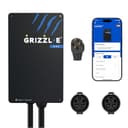
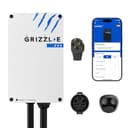
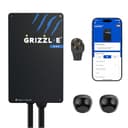
- A connector choice. Two J1772 cables, two NACS cables, or one of each — chosen at purchase.
What carried over is the reason to consider a Grizzl-E at all: a UL Type 4 indoor/outdoor cast-metal enclosure rated from −30 °C to +50 °C, 25 ft output cables, a 3-year warranty with a 5-year extension sold separately, and current adjustable from 40A down to 16A.
The certification, and the ENERGY STAR row that is not there
A charger holding its rated current for hours, unattended, in a garage, needs to have been tested by somebody. Our certification guide explains what each mark actually covers and how to check a claim yourself.
United Chargers publishes a UL/cUL listing under file E510712 for the Duo Connect, and the live Amazon listings describe it as “UL Tested and Certified”. That is the mark that matters most, and it is consistent across the manufacturer’s record and the retail listing.
ENERGY STAR is the part that does not line up cleanly. We queried EPA’s certified-EVSE database on 10 September 2026. It returns eight Grizzl-E models under the partner name United Chargers Inc. — Smart, Classic, Mini, Ultimate, Ultimate 48A, Ultimate Fleet 80A, Ultimate Pro 80A and Duo Smart 80A — and there is no Duo Connect row.
The Duo Smart 80A record is worth a closer look before anyone concludes either way, because ENERGY STAR records cover families rather than single SKUs. Its “additional model information” field lists eleven further model numbers, and several of them describe a 40A, NEMA 14-50, dual-cable unit (GRD-077-W-14-25J40-25J40-A-GB and its siblings, including the J1772/NACS and NACS/NACS pairings). That is the Duo Connect’s configuration. But it is not the SKU United Chargers publishes for the Duo Connect on its own store, which reads GRD-14-25J177240-B and similar.
So we are not going to tell you it is certified and we are not going to tell you it is not. What we will say plainly: if a utility rebate you are counting on requires ENERGY STAR, confirm the exact model number with the program before you order, because a rebate form asks for a model number and the one on your box may not be the one in the database. That is worth doing anyway; on a charger at this price a rebate is a meaningful share of the cost.
The circuit it needs, and the outlet to spend money on
At its full 40A output the Duo Connect needs a 50A breaker, because electrical code sizes a continuous load at 125% of its draw. Because current is adjustable from 40A down to 16A, the same box also runs on a 40A, 30A or 20A circuit at reduced output — 32A, 24A and 16A respectively. Our amps and circuits guide works through how to size this against what your panel can actually spare. Bear in mind that dialing the box down also halves the shared figure: on a 30A circuit, two cars charging together are getting 12A each.
United Chargers publishes this model as NEMA 14-50 plug-in only. No hardwired version and no NEMA 6-50 variant appear in its product record, so if your garage has a 6-50 outlet or you specifically wanted a hardwired install, this is not the unit. Our plug-in versus hardwired guide covers what you give up either way.
If you do buy it, spend money on the receptacle. This is a 40A continuous load held for hours a night through a plug, and inexpensive NEMA 14-50 outlets are built for the intermittent loads of ranges and RVs rather than that duty; overheated receptacles are a documented failure mode. An industrial-grade outlet is the cheapest safety upgrade in the whole job — our NEMA 14-50 outlet roundup covers the ones worth buying.
Which connector pairing to buy
The pairing is fixed at purchase and cannot be changed later, so this is the one decision on the page worth slowing down for.
- Two J1772 cables for two non-Tesla EVs. The default, and the configuration with the widest vehicle compatibility if the household’s cars change.
- One J1772 and one NACS for a mixed garage. This is the pairing that most justifies the product: each car gets the plug it was built for, and neither one needs an adapter left permanently hanging off a wall charger, which is a wear point we would avoid where there is a choice.
- Two NACS cables for two Tesla-port EVs. Worth comparing against two Tesla Wall Connectors, which deliver 48A each but must be hardwired and each want their own circuit.
If your household’s cars might change within the warranty period, the mixed pairing is the hedge, and a connector adapter covers the rest.
Who should skip it
- Two large-battery vehicles on a short overnight window. 20A each is the whole product, and it will not stretch.
- Anyone whose panel can spare a second circuit cheaply. Two single-port chargers cost less and each car gets full output.
- Anyone who wanted a Grizzl-E because it had no radio. The Wi-Fi is not optional here. The Lectron Nexus is the current no-network alternative, though it is a single-port unit.
- Anyone relying on an ENERGY STAR rebate who cannot get the model number confirmed by the program first.
- Anyone who needs a hardwired install or already has a NEMA 6-50 outlet. Neither is offered.
The verdict
A well-built answer to a real problem, sold to a narrower household than the marketing implies. The enclosure, the cable length, the temperature range and the UL file are all the reasons this brand has the reputation it does, and putting two cables on one plug-in circuit removes the single most expensive item in a two-EV install.
Buy it if an electrician has told you a second 50A circuit is awkward or expensive, and both your cars are ordinary daily drivers rather than large packs run flat every evening. Skip it if your panel has room to spare, because two single-port chargers are cheaper and faster per car. And whichever way you go, get the load calculation before you order anything — it is the number that decides which of these you can actually install, and it costs a service call.
One buying note. United Chargers sells the Duo Connect direct as well as on Amazon, and the two prices are not always the same. We earn a commission on the Amazon link and nothing on the direct one, and we would still rather you paid less — check both.