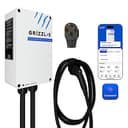
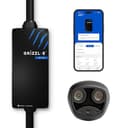
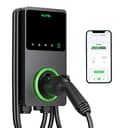
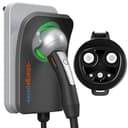
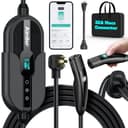
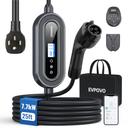
The six, side by side
Read from the same registry entries as the reviews above. The amperage column shows each unit’s maximum; the adjustable range is in the write-ups and in the table of settings below, because manufacturers publish it in prose rather than as a spec field.
| Product | Connector | Max output | Max power | Cable | Install | Warranty | Price |
|---|
| Grizzl-E Classic Connect 40A (J1772) | J1772 | 40 A | 9.6 kW | 25 ft | Plug-in (NEMA 14-50) | 3 years | |
|---|
| Grizzl-E Mini Connect 40A (NACS) | NACS (Tesla) | 40 A | 9.6 kW | 25 ft | Plug-in (NEMA 14-50, with four included adapters) | 3 years (5-year option sold by the manufacturer) | |
|---|
| Autel MaxiCharger Home | J1772 | 50 A | 12 kW | 25 ft | Hardwired (70A circuit for 50A); plug-in sold as separate 40A models | 3 years | |
|---|
| ChargePoint Home Flex NACS (Hardwired) | NACS (Tesla) | 50 A | 12 kW | 23 ft | Hardwired | 3 years | |
|---|
| AIMILER Level 2 32A NACS (Wi-Fi) | NACS (Tesla) | 32 A | 7.7 kW | 25 ft | Plug-in (NEMA 14-50) | 3 years | |
|---|
| EVPOVO Level 2 32A (NEMA 14-50) | J1772 | 32 A | 7.7 kW | 25 ft | Plug-in (NEMA 14-50) | 3 years | |
|---|
What setting fits what circuit
This is the table to take to your electrician. The left column is what the breaker is rated; the middle is the most a charger may draw continuously on it; the right is roughly what that adds to a typical EV per hour.
| Circuit | Charger setting | Output | Range per hour |
|---|
| 20 A | 16 A | ~3.8 kW | ~12 miles |
| 30 A (dryer circuit) | 24 A | ~5.8 kW | ~18 miles |
| 40 A | 32 A | ~7.7 kW | ~24 miles |
| 50 A | 40 A | ~9.6 kW | ~30 miles |
| 60 A | 48 A | ~11.5 kW | ~36 miles |
The range figures are arithmetic from the output, not a manufacturer claim, and they assume a reasonably efficient EV; a three-row SUV in winter will do worse. Note what the table shows about the top end: stepping from 40 to 48 A buys about six miles of range per hour that you spend asleep, and it costs you a 60-amp circuit. That is the whole argument on 40 amp vs 48 amp.
Three criteria, and one that is a trap
1. How wide is the published range?A charger that adjusts from 16 A covers every realistic residential circuit from 20 A upwards. One that adjusts from 32 A only helps if your panel was already healthy. The widest published range in our registry belongs to the Grizzl-E Mini family at 7–40 A; the Autel NACS unit publishes 6–50 A.
2. How do you change it, and does it stick? There are three mechanisms and they are not equivalent. Some chargers are set at installation by the electrician, which is the most robust arrangement and the hardest to tamper with. Some are set in an app, which is convenient and means the setting depends on a connected service. Some have physical buttons on the unit. The EVPOVO is a good example of belt and braces: its listing publishes app control or button control, so a dead phone is not a dead charger.
3. Is the whole range usable on your install route?This is where plug-in and hardwired diverge. A plug-in charger on a NEMA 14-50 cannot exceed 40 A whatever the dial says, because the receptacle is a 50-amp device. So a unit that advertises 50 A but ships with a plug is really a 40-amp charger with headroom for a future hardwire. Our plug-in and hardwired roundups cover that split properly.
The trap: adjustability cannot raise your car’s ceiling. Charging speed is the lower of the charger’s setting and the vehicle’s onboard charger. Plenty of EVs cap at 7.2 or 7.7 kW, which is 30 to 32 amps — on those cars, every amp above that setting is spent before it reaches the battery, and a 50-amp charger is a purchase for the next car rather than this one. Check the car first; our comparison chart lists what each charger can give, and the vehicle roundups list what each car can take.
The picks in detail
The Grizzl-E Classic Connect is the best balance of range and build.Sixteen to 40 amps adjustable, a NEMA 14-50 plug, a cast metal UL Type 4 indoor/outdoor enclosure with a published UL file number, a 25 ft cord, operation to −30 °C, Wi-Fi with scheduling and demand-response participation, and three years as standard. The honest cons: Wi-Fi is no longer optional on this line, whose original appeal was that there was no app to fail; it was not in EPA’s ENERGY STAR certified-EVSE database when we last checked, even though the Classic it succeeds is; and United Chargers publishes “40A 10 kW” on its own page against 9.6 kW on the listing — size the circuit from the amps, not from either kW figure. Full detail in our Classic Connect review.
The Grizzl-E Mini Connect has the widest published range we found.United Chargers publishes 7–40 A adjustment on the Mini, which is a genuinely useful span: 7 A is a trickle on a weak circuit and 40 A is a full overnight charge. It is a portable in a cast aluminum NEMA 4X housing with four named NEMA adapters in the box and a 25 ft cable, so it moves between a garage, a cabin and a campground. The cons: the published cable length disagrees with itself across the maker’s page, the listing and EPA’s record (plan for 24 ft), this NACS version suits a Tesla or other NACS-port EV rather than a J1772 car — the J1772 Mini is the sibling, and its listing is the non-connected model at a similar price — and it costs more than the wall-mounted Classic Connect. Our Mini Connect review sets that trap out in detail.
The Autel MaxiCharger is the pick when the dial has to reach high as well as low.Sixteen to 50 amps in the app, 12 kW at the top, IP65 / NEMA 4X, and a published operating range from −40 °F — the widest temperature span of any charger we cover, which is why it also leads our outdoor roundup. Three cons, and the first is the big one: Autel publishes a 70-amp circuit for full 50-amp output, which is more than many panels can spare; it is hardwired at that output, with the plug-in versions sold as separate 40-amp models; and Autel does not publish what sensor hardware its load-management feature needs, so you cannot cost that before buying.
The ChargePoint Home Flex NACS has the widest circuit compatibility on the page.ChargePoint publishes hardwire compatibility with breakers from 20 A to 80 A, with the output configured at installation — which is exactly the “one charger, whatever the panel allows” proposition, backed by a datasheet, a UL listing, ENERGY STAR certification, a Type 3R enclosure per UL 50E and a published −22 °F to 122 °F range. The cons: it is hardwired, so the setting is an electrician’s job rather than a dial you touch; it costs more than 48-amp units that deliver more power; and the J1772 version on Amazon is the NEMA 14-50 plug-in model that runs at 32 or 40 A, not the 16–50 A hardwired one — a model-naming trap we cover on our brand ranking.
The AIMILER 32A NACS is the adjustable pick for a Tesla on a modest circuit.Its listing does something we wish every brand did: it maps the settings to breaker sizes explicitly — 32 A for a 40-amp breaker, 24 A for a 30-amp, 16 A for a 20-amp — with a factory NACS handle, a 25 ft cable, NEMA Type 4 and IP66, Wi-Fi and a 3-year warranty. The cons: 32 A is the ceiling, so this is not the charger for a big battery on a short window; it is a smaller brand than the rest of this list; and its ENERGY STAR status sits under a certified family registered to a different brand name, which matters if a rebate form asks for a model number.
The EVPOVO 32A is the budget pick, and it is not a token one. Discrete 16, 20, 24 and 32 A settings, a 25 ft TPU cable rated flexible to −22 °F, app orbutton control, an ETL listing naming UL 2594 and UL 2231-1/-2, CCID20 leakage protection and three years — at a price well under half of everything above it. The cons: no published enclosure rating for the body, 32 A is the ceiling, and it is a portable-form unit rather than a wall station, so it wants an industrial-grade NEMA 14-50 receptacle behind it if it is doing daily duty.
Where adjustability earns its keep
Charging from a dryer outlet. This is the case that makes an adjustable charger genuinely necessary rather than merely nice. A NEMA 14-30 or 10-30 dryer receptacle sits on a 30-amp circuit, so the charger mustbe set to 24 A — and the one-foot adapter that makes the plug fit cannot do that for you. A fixed-40 A charger on a dryer circuit is an overload waiting to happen. Our dryer-outlet guide and NEMA adapter roundup both lead with that rule for the same reason.
An older or fully loaded panel.If the service is the constraint rather than the car, a dial is what lets you charge at all without a service upgrade — start at chargers for a 100-amp panel, which covers the load calculation and the load-management alternative.
Solar and off-peak charging.A 40-amp charger pulls about 9.6 kW, which is more than most residential arrays produce. Dialing to 16 or 24 A is what makes a midday session genuinely solar-fed rather than partly grid-fed, which is why the dial appears as a criterion on chargers for a home with solar as well.
And renting, or expecting to move.A unit that fits whatever circuit exists at the next address is worth more than one tuned to this one. Pair that with a plug-in install and the charger comes with you — see chargers for renters.