Amp & Adapter

NACS-to-CCS Adapters for a Nissan Ariya

Nissan's own Ariya kit names CCS as the charge port and sells a NACS adapter as a port-installed accessory. The redesigned Leaf went the other way entirely — and its owners need no adapter at all.

By Stephen V.Last updated How we rank

If you drive an Ariya, a NACS-to-CCS adapter is one of the few accessories on this site that genuinely changes where you can drive it. Nissan’s own 2025 Ariya press kit names “CCS Standard” as the charge port and publishes a 130-kW DC fast charger as standard equipment — so the car has real DC capability and a connector that does not fit the largest fast network in the country. That is exactly the gap an adapter closes.

If you drive the redesigned Leaf, close this page and keep your money. Nissan put a native NACS fast-charge port on it. Its press kit says the car’s “NACS fast charge port on the passenger’s-side fender unlocks the faster speeds of over 20,000 Tesla Superchargers” — no adapter in that sentence. A NACS-to-CCS adapter would do nothing for you, and we would rather say so than sell you one.

Two cars, one badge, opposite answers. Below is how to tell which situation you are in, the order to check things in before you spend anything, and the three adapters we would consider — ranked on the published safety standard first, because this is the single highest-current part you will ever hold in your hand.

We own no adapters and we bench-test nothing — here is exactly what we do instead. Every Nissan figure below is read from Nissan’s own US newsroom releases on the dates in the sources list, every adapter figure is what the seller publishes in its own listing, and prices come from our daily live check rather than being typed into the page.

How this is funded: we earn a commission if you buy through our links, at no extra cost to you. It never changes which product we recommend, and we’ll tell you plainly when we’d skip one. Full disclosure.

Quick picks

Ranked on published specs, install flexibility and buyer fit. Select a row to jump to the full write-up. We have not bench-tested these units — here is exactly what we do instead.

#ProductBest forPrice
1
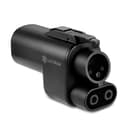
FOCSPROD NACS to CCS1 Adapter (Interlock, 500A)

FOCSPROD NACS to CCS1 Adapter (Interlock, 500A)

The mid-price NACS-to-CCS option that still publishes the two things that matter on a DC adapter: a UL 2252 reference and an electronic interlock. It sits between the budget units and the A2Z, and the interlock is the reason to prefer it over anything cheaper.

Best interlock for the money
$100.70 · View on Amazon

$125.9920% off

Price as of November 20, 2026. #ad How we’re funded

2
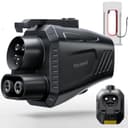
A2Z NACS to CCS1 Adapter (Typhoon Pro)

A2Z NACS to CCS1 Adapter (Typhoon Pro)

This is the DC-fast adapter that lets a CCS car (before its NACS retrofit) pull power from a Tesla Supercharger. A2Z's version is the enthusiast favorite for build quality and higher sustained current — a serious piece of kit, priced like one.

Best built
$169.99 · View on Amazon

Price as of November 20, 2026. #ad How we’re funded

3
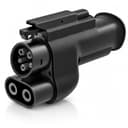
Lectron Vortex Plus NACS to CCS1 Adapter (with Interlock)

Lectron Vortex Plus NACS to CCS1 Adapter (with Interlock)

The only NACS-to-CCS adapter in this registry whose maker publishes a full specification table AND names a third-party safety certification for it — UL 2252, the standard written for this exact device, certified by SGS. It costs more than the A2Z and a lot more than the cheapest UL 2252 listing we have found, and what the money buys is the paper trail rather than a higher current ceiling.

Best-known brand
$169.99 · View on Amazon

$199.9915% off

Price as of November 20, 2026. #ad How we’re funded

The picks in full

#1Best interlock for the money

FOCSPROD NACS to CCS1 Adapter (Interlock, 500A)

The mid-price NACS-to-CCS option that still publishes the two things that matter on a DC adapter: a UL 2252 reference and an electronic interlock. It sits between the budget units and the A2Z, and the interlock is the reason to prefer it over anything cheaper.

Strengths

  • Publishes an electronic interlock, so the adapter cannot be pulled off under load
  • Rated to 500A / 1000V — the full envelope of a Supercharger stall
  • Cites UL 2252, the standard written for exactly this part

Trade-offs

  • Smaller brand than Lectron or A2Z, with less of a support track record
  • Supercharger access still depends on your vehicle and account being enabled — the adapter alone is not enough
  • The listing does not publish a warranty term or a cable/handle weight
ConnectorNACS → CCS1
Max output500 A
Max powerNot published
Cable lengthNot published
InstallPlug-on adapter
Outdoor ratingNot published
WarrantyNot published

Spec note. The listing publishes a maximum 500A / 1000V rating, an interlock mechanism and a UL 2252 reference. It does not publish a kW figure, a warranty term or an operating temperature range, so those read as not published. Confirm your own vehicle is enabled for non-Tesla Supercharging before buying any adapter.

Specs read from the product listing, on August 11, 2026. “Not published” means the manufacturer does not state that figure.

#2Best built

A2Z NACS to CCS1 Adapter (Typhoon Pro)

This is the DC-fast adapter that lets a CCS car (before its NACS retrofit) pull power from a Tesla Supercharger. A2Z's version is the enthusiast favorite for build quality and higher sustained current — a serious piece of kit, priced like one.

Strengths

  • Unlocks the Tesla Supercharger network for a CCS1 vehicle
  • Built for high sustained DC current with a metal housing
  • Widely reported to work across V3 Superchargers with Magic Dock-style support

Trade-offs

  • Expensive — this is the priciest adapter category by far
  • Your car and the network must both allow it; compatibility is vehicle-specific
ConnectorNACS (Tesla) → CCS1
Max outputNot published
Max power500 kW
Cable lengthNot published
InstallPlug-on DC adapter
Outdoor ratingNot published
Warranty1 year

Spec note. DC fast charging adapter. Compatibility depends on the specific vehicle and the Supercharger site — confirm your car is on the supported list before relying on it for a trip.

Specs read from the product listing, on September 23, 2026. “Not published” means the manufacturer does not state that figure.

#3Best-known brand

Lectron Vortex Plus NACS to CCS1 Adapter (with Interlock)

The only NACS-to-CCS adapter in this registry whose maker publishes a full specification table AND names a third-party safety certification for it — UL 2252, the standard written for this exact device, certified by SGS. It costs more than the A2Z and a lot more than the cheapest UL 2252 listing we have found, and what the money buys is the paper trail rather than a higher current ceiling.

Strengths

  • Lectron publishes a real specification table: 500A DC, 1,000V DC, up to 500 kW, IP67, -22°F to 122°F, 2 lb
  • Certified to UL 2252 by SGS per Lectron's own FAQ — the standard written for NACS adapters, and a claim most listings in this category do not make
  • Two-year warranty, double the term most adapter listings publish
  • Lectron states built-in thermal protection that can reduce or pause power, and a dual interlock that "secures at both ends"
  • Lectron names the 25 automakers it says have Supercharger access, so the compatibility question has a published starting point

Trade-offs

  • Lectron states it supports V3 and V4 Superchargers and "does not support V2 Superchargers" — if your usual site is a V2, this adapter is not the answer
  • DC only: Lectron says plainly it will not work on Tesla Wall Connectors or Destination Chargers, which is where new owners most often try an adapter first
  • No dimensions, no UL certificate number and no interlock mechanism detail are published
  • A rival listing claims the same UL 2252 certification at well under this price, so you are paying for the brand and the warranty, not for a higher rating
  • Still a per-vehicle question: approval belongs to the automaker, not to the adapter
ConnectorNACS (SAE J3400) → CCS1
Max output500 A
Max power500 kW
Cable lengthNot published
InstallPlug-on DC adapter
Outdoor ratingIP67
Warranty2 years

Spec note. Lectron's own page publishes "Rated Current 500A DC", "Rated Voltage 1,000V DC", "Max. Power Up to 500 kW", "Charger Connector NACS (SAE J3400)", "Vehicle Connector CCS1", "Weatherproof Rating IP67", "Operating Temperature -22°F to 122°F", "Weight 2 lbs", "Materials PC / PA66 / Copper", "Safety Certification UL 2252" and "Warranty 2 Years", and the FAQ adds that it is certified to UL 2252 by SGS, that it supports compatible Tesla V3 and V4 Superchargers but NOT V2 Superchargers, and that it is DC-only — not for Tesla Wall Connectors or Destination Chargers. The 500A/1,000V/500 kW figures are the adapter's RATING, not a charging speed: the delivered rate is set by the Supercharger and by the car. No dimensions, UL certificate number, storage temperature or interlock mechanism detail is published.

Specs read from the product listing, on November 2, 2026. “Not published” means the manufacturer does not state that figure.

Which Nissan are you actually standing next to?

Nissan sells two very different charging architectures at the same time, and the model name on the tailgate does not settle it. Walk out to the car and look at the fenders before you buy anything.

The Ariya has one port, on the nose, and it is CCS1.Nissan’s 2025 Ariya press kit lists “CCS Standard” as the charge port across the range, together with a 130-kW DC fast charger as standard equipment and a NACS Adapter offered as a port-installed accessory on every trim — the kit lists that accessory at $235. A CCS1 inlet takes a J1772 handle for AC at home and the full combo handle for DC, which is why the Ariya is a textbook adapter candidate: the car can fast-charge properly, it simply cannot fit a Supercharger cable without help.

The redesigned Leaf has two ports, on opposite fenders.Nissan’s 2026 Leaf press kit describes “a familiar J1772 charge port on the driver’s-side fender” for home and Level 2 public charging, and separately “the NACS fast charge port on the passenger’s-side fender” for Superchargers. Nissan publishes DC fast charging from 10% to 80% in 35 minutes at up to 150 kW on that port. There is no CCS inlet on the car at all, so there is nothing for a NACS-to-CCS adapter to adapt.

An older Leaf is a third case again, and the oldest one is CHAdeMO. Nissan’s 2025 Leaf press kit — the outgoing car — publishes a 6.6 kW onboard charger (6.0 kW output), a 40 kWh battery on the S and 60 kWh on the SV PLUS, and quick charging to 80% in 40 or 60 minutes. Nothing on this page helps that car reach a Supercharger. If that is what you own, the honest answer is that the DC network available to you is the one you already have.

Three things must all be true before an adapter does anything

This is the part that produces most of the one-star reviews on every adapter listing, and almost none of it is the adapter’s fault. Buying the hardware is the last step, not the first.

  1. Your car has to be a CCS1 car. Covered above. If it is a new-generation Leaf, stop here.
  2. Your account has to be enabled for non-Tesla Supercharging, in the Tesla app, with a payment method attached. The stall will not start a session for a vehicle it does not recognize as enrolled, no matter what is plugged into it.
  3. The specific site has to be open to non-Tesla vehicles,and the stall has to physically reach your inlet. The Ariya’s port is on the nose and Supercharger cables are built for a car that parks with its left rear corner at the post, so expect to park creatively at some sites.

Our Supercharger access guide for non-Tesla EVs walks those three conditions in order and is worth ten minutes before you spend anything. The short version: check your account first, because it is free to check and it is the condition that fails most often.

What an adapter changes on an Ariya, and what it does not

An adapter is a passive connector translator. It cannot raise a ceiling the car sets. On an Ariya the ceiling Nissan publishes is a 130-kW DC fast charger, and the kit puts real numbers behind it: a quick charge of roughly 35 minutes on the 66 kWh pack and 40 minutes on the 91 kWh pack at 130 kW, stretching to 65 and 90 minutes at a 50-kW charger.

So the adapter does not make your Ariya faster than 130 kW. What it does is make the difference between 130 kW and 50 kW available in far more places, because it adds the densest fast network in the country to your map. On a long drive, the gap between a 35-minute stop and a 90-minute stop repeated twice is the entire character of the trip. That is the real purchase here — coverage that happens to come at the car’s own best speed, rather than extra speed.

It is also worth being blunt about what happens at the stall. A non-Tesla car plugged into a Supercharger through an adapter frequently does not hit its headline peak, the curve tapers hard above 80% exactly as it does on any other network, and a cold battery will cost you more time than the connector ever will. Our guide on whether a NACS-to-CCS adapter slows charging takes that apart properly. The adapter is almost never the bottleneck.

How we ranked these three

Everything on this page carries up to 500 amps of DC through a hand-held joint, which makes it the most safety-sensitive product category on this site. We rank on what the seller is willing to publish, in this order:

  • A named safety standard.UL 2252 is the standard written for exactly this part. A listing that names it has made a specific, checkable claim; a listing that says “safety certified” has made none. Our certification guide explains the difference between a standard and a slogan.
  • An electronic interlock. This is the mechanism that stops the adapter being pulled off the handle while current is flowing. On a 500-amp DC joint that is not a convenience feature.
  • A published current and voltage envelope. 500 A / 1000 V covers the full envelope of a Supercharger stall. A listing that publishes no figure is asking you to assume.
  • A warranty term, in writing. Two of the three below publish one year. One publishes nothing, and we have said so on its card rather than rounding it up.

Price is the last tiebreaker, not the first. The full category, including the units that did not make this page, is in best NACS-to-CCS adapters, and Lectron vs A2Z puts picks two and three head to head on their published figures.

Buy Nissan’s own adapter or a third-party one?

Check Nissan’s route first. The 2025 Ariya kit lists a NACS Adapter as a port-installed accessory available on every trim, at $235 in that document. An automaker-supplied part has been validated against your car’s own charging hardware and removes any argument about warranty if something goes wrong at a stall, which is worth real money on a part in this category.

A third-party adapter makes sense in two situations: your dealer cannot supply the factory part, or you want a second one to live permanently in the frunk so the first one is never the thing you left at home. In either case, buy on the published standard rather than the price — and treat any listing that will not name UL 2252 as a listing that has told you something.

The home-charging side is a completely different purchase

None of this touches your garage. DC adapters are a road-trip item; the charger on your wall is an AC item, and on an Ariya the AC story is unusually simple. Nissan publishes a 7.2-kW onboard charger standard on every Ariya grade, FWD and e-4ORCE alike — about 30 amps at 240 volts — with a 0–100% Level 2 charge time of 10.5 hours on the 66 kWh pack and 14 hours on the 91 kWh pack.

That figure means the 48-amp charger the internet recommends to everybody cannot give this car one extra kilowatt. We made that argument in full, with the picks that follow from it, in best home EV chargers for a Nissan Ariya. Leaf owners have their own page at best home EV chargers for a Nissan Leaf, and the same 7.2-kW ceiling applies there on the current car.

One Leaf detail worth carrying across: because the new car’s AC port is J1772 and its DC port is NACS, a Leaf owner who wants to use a Tesla Wall Connectorat a friend’s house needs a NACS-to-J1772 AC adapter — a different, much cheaper part, covered in best Tesla-to-J1772 adapters. Nissan also notes that the Leaf’s 1,500-watt V2L function “requires adapter for exterior J1772 port”, which is a third adapter again. The word “adapter” is doing a lot of different jobs in this corner of the market, and buying the wrong one is the most common mistake we see.

The short answer

Ariya: yes, if you road-trip. Check your Tesla account is enrolled before you buy, price the factory accessory first, and if you go third-party, buy the one that publishes an interlock and names UL 2252 — pick one does both for the least money, and pick two is the one to buy if you would rather pay for the better-built housing and the longer track record. New Leaf: no, you already have the port. Older Leaf: no, and no adapter on the market changes that.
Frequently asked questions

Does a Nissan Ariya need a NACS-to-CCS adapter to use a Supercharger?

Yes. Nissan's own 2025 Ariya press kit lists "CCS Standard" as the charge port, and a Supercharger cable is a NACS connector, so the two do not fit without an adapter. Nissan also offers a NACS Adapter as a port-installed accessory on every Ariya trim, listed at $235 in that press kit. Whichever adapter you use, your Tesla account must be enrolled for non-Tesla Supercharging and the specific site must be open to non-Tesla vehicles before a session will start.

Does the new Nissan Leaf need a NACS-to-CCS adapter?

No. Nissan's 2026 Leaf press kit describes a NACS fast-charge port on the passenger's-side fender that "unlocks the faster speeds of over 20,000 Tesla Superchargers", alongside a separate J1772 port on the driver's side for home and Level 2 charging. The car plugs into a Supercharger directly, so a NACS-to-CCS adapter would have nothing to connect to.

How fast can a Nissan Ariya charge at a Supercharger?

No faster than the car itself allows. Nissan publishes a 130-kW DC fast charger as standard on the Ariya, with a quick charge of approximately 35 minutes on the 66 kWh pack and 40 minutes on the 91 kWh pack at 130 kW, against 65 and 90 minutes at a 50-kW charger. An adapter does not raise that ceiling — what it buys you is many more places to hit it.

What should I look for in a NACS-to-CCS adapter?

A named safety standard first — UL 2252 is the one written for this part — then an electronic interlock so the adapter cannot be pulled off under load, then a published current and voltage envelope (500 A / 1000 V covers a Supercharger stall), then a warranty term in writing. Price is the last tiebreaker. A listing that says "safety certified" without naming a standard has not made a claim you can check.

Is Nissan's own adapter better than a third-party one?

It is the safer default. A factory accessory has been validated against your car's own charging hardware and removes warranty ambiguity if something fails at a stall. Third-party adapters make sense when the dealer cannot supply the part, or when you want a spare that lives in the car permanently — in which case buy on the published standard rather than the price.

My Ariya will not start a session at a Supercharger. Is the adapter faulty?

Usually not. Three things fail far more often: your Tesla account is not enrolled for non-Tesla Supercharging, that particular site is not open to non-Tesla vehicles, or the car's charging software is out of date. Check all three before you blame the hardware. Parking geometry is the fourth — the Ariya's port is on the nose and Supercharger cables are built for a car that backs in.

Can I use a NACS-to-CCS adapter on a Tesla Wall Connector at home?

No, and this is the most common mix-up in the category. A NACS-to-CCS adapter is a DC fast-charging part. A Tesla Wall Connector delivers AC, which on a CCS1 car goes into the J1772 half of the inlet, so what you need there is a NACS-to-J1772 AC adapter — a different and much cheaper product.

Sources

  • Nissan USA Newsroom — 2025 Ariya Press Kit — Nissan's own Ariya release: a "7.2-kW onboard charger" standard on every grade (FWD and e-4ORCE), a "130-kW DC fast charger" standard, "CCS Standard" as the charge port, a "NACS Adapter" listed as a $235 port-installed accessory on all trims, batteries of 66 kWh total / 63 kWh usable (standard range) and 91 kWh total / 87 kWh usable (long range), a Level 2 0-100% charge time of "10.5 hours" on the 66 kWh pack and "14 hours" on the 91 kWh pack, quick-charge figures of 35 and 40 minutes at 130 kW and 65 and 90 minutes at 50 kW, and range by trim from 205 to 289 miles. The kit publishes no charger amperage and no circuit guidance (accessed October 19, 2026)
  • Nissan USA Newsroom — 2026 Nissan LEAF Press Kit — Nissan's own release for the redesigned Leaf: a 7.2 kW onboard charger standard on S+, SV+ and PLATINUM+, a 75-kWh liquid-cooled pack, "a familiar J1772 charge port on the driver's-side fender allows for plugging in at home and many Level 2 public chargers", "the NACS fast charge port on the passenger-side fender unlocks the faster speeds of over 20,000 Tesla Superchargers", DC fast charging from 10% to 80% in 35 minutes at up to 150 kW, 303/288/259 miles of range by trim, V2L of 1,500 watts that "requires adapter for exterior J1772 port", a portable charge cable (120V / 240V EVSE) as standard equipment, and a 240V charging time still listed as TBD (accessed September 25, 2026)
  • Nissan USA Newsroom — 2025 Nissan LEAF Press Kit — Nissan's own release for the outgoing Leaf: a "6.6 kW onboard charger (6.0 kW output)", a 40 kWh battery on the S and 60 kWh on the SV PLUS (149 and 212 miles), an estimated 240V charging time of "~ 11.5 hours", quick charge to 80% in 40 minutes (S) or 60 minutes (SV PLUS), and a portable charge cable (120V / 240V EVSE) in the standard equipment list (accessed September 25, 2026)
  • U.S. DOE Alternative Fuels Data Center — Charging Electric Vehicles in Public — DOE guidance on public AC and DC fast charging (accessed July 19, 2026)
  • U.S. DOE Alternative Fuels Data Center — Electric Vehicle Charging Stations — DOE overview of charging levels, power output and connector types (J1772, CCS, NACS) (accessed July 19, 2026)
  • SAE International — J3400 North American Charging System (NACS) for Electric Vehicles — The SAE standard for the NACS connector (Tesla's plug), alongside the J1772 AC standard (accessed July 19, 2026)
  • U.S. DOE Alternative Fuels Data Center — Electric Vehicles for Consumers — DOE consumer overview of EV ownership, range and charging (accessed July 19, 2026)

Keep reading