Get the variant question out of the way first
Both of these are product families, not products, and comparing the wrong members of them is how people end up disappointed.
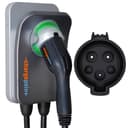
ChargePoint sells the Home Flex as three separate models.Its own home-charging page is explicit: the hardwired unit “Works with circuits rated from 20 to 80A” and “Delivers up to 50A of power”, while both plug-in models — NEMA 14-50 and NEMA 6-50 — “Work with circuits rated 40 or 50A” and “Deliver up to 40A of power (30 miles of range per hour)”. The famous 16-to-50-amp dial belongs to the hardwired model. At the time of writing, Amazon lists the NEMA 14-50 plug-in version, and that is the unit this page compares and links to.
Wallbox sells the Pulsar Plus in 40-amp and 48-amp versions.Its own page says “Choose between 40 and 48 Amps” and that “Pulsar Plus 40A offers easy NEMA 14-50 plug installation” — while saying nothing at all about how the 48-amp model connects. The 48-amp unit is the hardwired one, which is not a Wallbox quirk: no genuine 48-amp charger in this category runs on a plug, because the continuous-load rules push a 48-amp load onto a 60-amp circuit. We make that argument properly in 40 amp vs 48 amp.
So the honest framing of this comparison is 40-amp plug-in against 48-amp hardwired, which means the first question is not about brands at all. It is whether you are paying an electrician. If you are not, the Wallbox 48 is not on your list; if you are, the ChargePoint plug-in is the one giving something away.
The published figures, side by side
Every row is each maker’s own published figure or the figure in the live listing we link to. Where a maker publishes nothing, the cell says so rather than borrowing a number from somewhere else.
| Specification | ChargePoint Home Flex (NEMA 14-50) | Wallbox Pulsar Plus |
|---|
| Output | Up to 40 A / 9.6 kW | 40 A or 48 A / up to 11.5 kW |
| Install | NEMA 14-50 plug; hardwired and NEMA 6-50 are separate models | 40 A on a NEMA 14-50 plug; 48 A hardwired |
| Circuit published | 40 or 50 A for the plug-in models | Not published on Wallbox’s US page |
| Cable | 23 ft | 25 ft |
| Connector | J1772 or NACS by model | “SAE J1772, NACS”, no adapters needed |
| Enclosure | Type 3R per UL 50E, on ChargePoint’s own datasheet | NEMA 3R per the retail listing; not published on Wallbox’s own page |
| Temperature range | −30 °C to 50 °C (−22 °F to 122 °F) | Not published |
| Standards named | UL and cUL to UL 2594, UL 2231-1, UL 2231-2; NEC Article 625; ENERGY STAR | Not named on Wallbox’s US page |
| Load management | App scheduling and utility rate integration | “Dynamic Load Management”; solar charging requires a Wallbox Power Meter |
| Warranty | 3 years | 3 years per the listing; not stated on the maker’s page |
Where the eight amps actually go
The headline gap is 9.6 kW against 11.5 kW, which sounds decisive and usually is not. Two things blunt it.
The first is the car. Most EVs on US roads cannot draw 48 amps on AC. A Nissan Ariya publishes a 7.2-kW onboard charger, which is about 30 amps — both of these chargers are overkill for it. A BMW i4 publishes 9.6 kW, which the ChargePoint matches exactly and the Wallbox cannot exceed. The cars that genuinely use 11.5 kW are a real but narrow set: a Kia EV9 at 10.9 kW, a Cadillac LYRIQ at 11.5 kW, a Toyota bZat 11 kW. Before you pay for 48 amps, find out what your own car accepts — our 48-amp roundup opens with exactly that question.
The second is how long the car is parked. The difference between 9.6 and 11.5 kW is roughly 20% more energy per hour. Over a 90-mile commuting day that is the difference between about three hours and about two and a half, both of which finish long before morning. It matters on a big battery after a long drive, and it matters almost not at all on a Tuesday.
What the eight amps definitely cost you is the circuit. A 48-amp charger wants a 60-amp breaker and a permanent connection; a 40-amp plug-in charger runs on the 50-amp 14-50 circuit many garages already have, and if yours does not, what the install actually costs is the page to read before you choose. On a tight panel the question changes shape again — see best chargers for a 100-amp panel.
The published-specification gap, and why we weight it
This is the part of the comparison that moved our ranking, so it is worth being precise about what we are and are not saying.
ChargePoint puts a CPH50 datasheet online. It states a “Station Enclosure Rating Type 3R per UL 50E”, an operating ambient of −30 °C to 50 °C, storage down to −40 °C, operating humidity to 95%, a 23-foot cable, and UL and cUL listing to UL 2594, UL 2231-1 and UL 2231-2 with NEC Article 625 compliance. Its home-charging page adds ENERGY STAR certification, a three-year warranty and 24/7 support. Every one of those is a checkable claim.
Wallbox’s own current US page publishes the connector types, “Up to 11.5 kW”, a 25-foot cable, the 40/48-amp choice, Bluetooth and Wi-Fi, an LED status light and Dynamic Load Management. It does not publish an enclosure rating, a temperature range, dimensions, a weight, a certification or a warranty term; it links to a datasheet and a warranty page instead of stating them. The Canadian page carries the same copy and the same omissions.
That is not a claim that the Wallbox is uncertified or badly sealed. The retail listing we link to publishes a NEMA 3R enclosure and a three-year warranty, and Wallbox is a serious manufacturer selling into a market that requires UL listing. It is a claim about what you can verify before you buy, and about which figure you will be able to point at in two years when you need to argue with somebody about a failure. On a device that lives outdoors on a 60-amp circuit, we weight that. If you want the reasoning in full, it is in what EV charger certifications actually mean.
Size, cable and the wall you are mounting to
The Pulsar Plus’s genuine, non-spec-sheet advantage is physical. It is the smallest 48-amp unit in our registry, which matters more than buyers expect in a single-car garage where the charger shares a wall with a water heater, a panel and a shelf. Two extra feet of cable — 25 against 23 — is also a real difference; cable reach is the spec people discover they got wrong after the unit is on the wall, which is why we built best long-cable chargers as its own page.
The flip side, and we would not call it a dealbreaker: a compact body leaves less room for the cable to live when it is not in use, so plan for a holster or a cable hook rather than draping 25 feet of cable over the unit.
Apps, networks and the thing neither of them tells you
ChargePoint’s app is the most mature in home charging, largely because it is the consumer face of a public network: scheduling, energy tracking, utility rate integration and an account that follows you to public stations. Wallbox’s app handles scheduling and status, and its Dynamic Load Management keeps charging within the house’s limit — useful on a constrained service, with the caveat that Wallbox states solar charging “Requires Wallbox Power Meter”, which is extra hardware and extra money.
The thing neither maker leads with is that a large share of owners stop opening the app within a month. If you know that is you, the app is not worth paying for in either direction, and chargers without Wi-Fi is a legitimate place to look instead. If you are on a time-of-use rate, scheduling genuinely pays for itself, and what it costs to charge at home shows the arithmetic on your own rate.
Honest cons on both
- ChargePoint Home Flex (plug-in): it costs more than bare 48-amp hardwired units that deliver more power, the 16-to-50-amp range that made the Home Flex famous belongs to the hardwired model Amazon does not currently list, and the app-forward design is more than a set-and-forget owner needs.
- Wallbox Pulsar Plus:the 48-amp version is hardwired only, so there is no plug route at full output; the compact body makes cable management tighter; and the maker’s own US page publishes none of the ratings a buyer would want to check, which leaves you relying on the retail listing.
The short answer
Existing 14-50 outlet, ordinary car, no electrician in the budget: ChargePoint Home Flex, and you will not feel the missing eight amps. Hardwiring anyway, tight wall, or a car that genuinely accepts 11.5 kW: Wallbox Pulsar Plus, with your eyes open about what Wallbox does not publish. If neither of those describes you, the field is wider than two units — best home EV chargers ranks the whole category, and Emporia vs ChargePoint Home Flex is the comparison to read if price is the binding constraint.