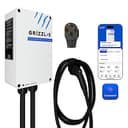
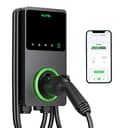
Everything both makers publish, side by side
Where a cell says “Not published,” that is the finding, not a gap we could not be bothered to fill. We have deliberately not borrowed a figure from a retail listing to patch a maker’s silence, because the pattern of what each company is willing to put in writing is most of this comparison.
| Specification | Autel AC Elite Home 50A | Grizzl-E Classic Connect 40A |
|---|
| Maximum output | 12 kW at 50 A, adjustable 16-50 A | "40A 10kW", adjustable 40-16 A |
| Circuit needed for full output | 70 A circuit | 50 A circuit (NEMA 14-50) |
| Install route | Hardwired; wall or pedestal | Plug-in, NEMA 14-50 |
| Connector | SAE J1772 (NACS model sold separately) | SAE J1772 or NACS |
| Cable length | 25 ft (7.5 m) | 25 ft (7.6 m) |
| Enclosure rating | IP65 / NEMA 4X | UL Type 4 indoor/outdoor |
| Operating temperature | -40 to 131 °F | -22 to 122 °F (-30 to +50 °C) |
| Certifications named by the maker | CSA and ENERGY STAR; no UL listing named | UL/cUL, file E510712 |
| Connectivity | Bluetooth, Wi-Fi, Ethernet, CAN, RS485 | Wi-Fi (2.4 GHz), app |
| Load management | ALM (requires additional hardware) and DLB between chargers | None published beyond the 16-40 A current setting |
| Electrical protection | Over-current, over/under-voltage, integrated surge protection | Not published |
| Warranty | 3 years | 3 years or 5 years, by choice |
| Weight | 15.4 lb with in-body holster | 24.25 lb as shipped (carton included) |
| Enclosure size | 13.2 x 7.4 x 3.8 in | 10.25 x 6.25 x 3.75 in |
The 70-amp circuit is the real decision
Autel publishes it plainly on its own store page: a 70-amp circuit for full output on the 50-amp model. That is the figure to take to whoever is quoting the work, and it is where the comparison usually ends.
A 70-amp circuit is a serious ask. It means heavier conductors, a bigger breaker and enough spare capacity in the service for a continuous 50-amp load on top of everything else the house does. On a 100-amp panel it is generally not happening without load management or a service upgrade — our 100-amp panel page works through what fits in that budget, and amps, circuits and the 125% rule explains the arithmetic behind every number on this page.
The Grizzl-E’s requirement is a 50-amp circuit terminating in a NEMA 14-50 receptacle, which is both a smaller ask and, crucially, a thing many garages already have— put there for an RV, a welder or a dryer. If yours does, the Grizzl-E’s installation cost can be zero. See the outlet page for why the receptacle itself still matters (the $10 hardware-store one is not the one you want behind a continuous 40-amp load), and what an install actually costs for the rest of the invoice.
Here is the uncomfortable follow-on for the Autel. You can set it to 40 amps instead and run it on a 50-amp circuit — its published input rating lists discrete steps of 16, 24, 32, 40, 48 and 50 amps. But at that point you have bought a 50-amp charger, paid 50-amp money, and are getting 40-amp performance from a hardwired unit. The Grizzl-E does 40 amps for less and plugs in. The Autel is worth its premium when you can actually use the 50, or when you want what comes with it.
What 50 amps versus 40 amps really buys
Autel publishes 12 kW at 50 amps. Grizzl-E publishes “40A 10kW”, which is its own rounding — 40 amps at 240 volts is 9.6 kW, and the retail listing for the same unit says 9.6 kW. We are not going to pretend 10 and 9.6 are the same number, so treat it as 9.6 kW and note that the maker rounds up.
So the real gap is 12 kW against 9.6 kW: about 25% more power per hour. In range terms that is roughly the difference between adding around 30 miles an hour and around 37, depending on the car.
Whether that matters comes down to one question: how many hours does your car sit plugged in?If it is parked from 7pm to 7am, both chargers finish long before you need the car, and the 25% is invisible. It starts to matter when you charge in short windows — a two-hour top-up before an evening out, a household where two cars share one charger, or a vehicle with a very large battery. Our 40A vs 48A page makes that argument in full, and the conclusion there applies here: most households buy more amps than their parking habits can use.
One more thing the table hides: your car may not accept 50 amps anyway. A great many EVs cap their onboard AC charger at 7.7 or 11.5 kW, and anything above that is headroom you are paying for and will never see. Check your vehicle’s published onboard charger rating before you buy amps — several of our home charger pages list it per model.
The certification inversion
This is the finding we did not expect, and it is the one we would most want a buyer to know.
Grizzl-E publishes a UL file number on its own page: “UL/cUL E510712.” That is a specific, checkable record for a specific product family. On a device that carries 40 continuous amps on a wall in a garage, a listed product with a file number is the single most reassuring thing a maker can publish.
Autel’s own store page names CSA and ENERGY STAR and does not name a UL listing anywhere. We read the page in full on the date below and the word does not appear in its certification text. That is not a safety accusation — CSA is a legitimate North American certification body and an ENERGY STAR mark means the unit is on EPA’s certified list with its efficiency measured. It is a transparency finding: the more expensive, more connected charger tells you less about its own listing status than the cheaper metal box does.
For what the various marks actually cover, our certification guide decodes UL 2594, UL 2231, ETL and ENERGY STAR, and the ENERGY STAR roundup is the field filtered to units with a certified record — which is where this one genuinely counts in the Autel’s favor, because some utility rebates require it.
Enclosure and weather: a close call, decided differently than you would guess
Autel publishes IP65 / NEMA 4X. Grizzl-E publishes UL Type 4 indoor/outdoor. These are closer than they look and both are genuinely good:
- Type 4 and 4X both mean the enclosure keeps out windblown dust and hose-directed water. The Xadds corrosion resistance, so on paper the Autel has the edge — relevant if you are near salt air or a coastal road.
- IP65 is dust-tight and resistant to water jets, broadly consistent with Type 4. Autel publishing both systems is useful rather than redundant.
- Temperature is the clearer win for Autel:−40 to 131 °F against the Grizzl-E’s −22 to 122 °F. If you are in Minnesota or Phoenix, that is not a trivia point. Our cold-weather page explains why the low end matters more than owners expect.
But here is the counterweight, and it is the thing enclosure ratings do not cover: ultraviolet light. No NEMA or IP figure says anything about sun, and sun is what actually ages an outdoor charger — housings chalk, cable jackets stiffen. A metal-cased unit under an eave will outlive a polymer one in full sun whatever the ratings say. If either of these is going on a wall with no overhang, read covers and enclosures and the outdoor roundup before you mount anything.
On size, the Grizzl-E is the smaller box on the wall — 10.25 x 6.25 x 3.75 in against the Autel’s 13.2 x 7.4 x 3.8 in. On weight the figures are not comparable and we will not pretend they are: Autel publishes 15.4 lb for the unit with its in-body holster, while Grizzl-E’s 24.25 lb is a shipped weight that includes the carton. Treat the Grizzl-E as the heavier-feeling of the two, because it is a metal case, but do not read the gap as nine pounds.
Load management: the Autel’s real argument, with a catch
This is where the Autel earns its money, and it is not the app.
Autel publishes two distinct features. Adaptive Load Management (ALM) shares power between the charger and other loads in the home, so the charger backs off when the dryer starts rather than tripping the main. Dynamic Load Balancing (DLB)splits capacity between multiple chargers. Grizzl-E publishes neither: its only power control is the adjustable 16–40 amp current setting, which is set once at install and does not react to anything.
The catch is published too, and it is easy to miss: Autel’s own specification table says “ALM Requires Additional Hardware” and does not name the hardware. DLB, by contrast, is described as working between chargers without additional hardware. So the feature that would let you run 50 amps on a panel that cannot really spare 70 is the one with an unpriced accessory attached to it. Ask the installer exactly what that part is and what it costs before you plan around it.
If load management is the reason you are shopping at all, our load-management guide covers how these systems work and best chargers for two EVs covers the two-car case, where DLB is the entire argument.
Connectors, variants and the plug-in question
Both brands sell a NACS version, which matters if your car has a Tesla-shape port and you would rather not live with an adapter dangling off the handle. Grizzl-E names both “Type 1 (SAE J1772); NACS” on a single specification page; Autel sells its NACS unit as a separate model at a higher price. Our best chargers for a Tesla page is the field filtered to factory-NACS units.
On install type, there is a point in the plug-in column that is not about convenience. A plug-in charger is a receptacle installation, and receptacles installed for EV charging fall under GFCI requirements that a hardwired charger does not — which is also the source of the well-documented nuisance-tripping interaction between a charger’s own internal ground-fault protection and an external GFCI breaker. That is a real argument in the hardwired Autel’s favor, and the reason we do not treat “it plugs in” as a free win. Our hardwired vs NEMA 14-50 guide works through both sides.
The flip side, equally real: a plug-in charger can be unplugged and taken with you. For a renter, or anyone who might move within the warranty period, that is worth more than any spec on the table — see best chargers for renters.
Warranty, and the one number Grizzl-E wins outright
Autel publishes three years. Grizzl-E publishes a choice of three or five years on the same product page.
Five years on a charger is unusual — most of the field sits at two or three — and it is the longest term either of these makers offers. On hardware that lives outdoors and gets handled every day, warranty length is a reasonable proxy for how much confidence a manufacturer has in its own build, and it is one of the few comparisons on this page where the cheaper product simply wins.
Two caveats so this is not read as a free lunch. The five-year option is presented as a choice on Grizzl-E’s page, which generally means it is a paid upgrade rather than standard — confirm what the listing you buy actually includes. And on the country-of-origin question: Grizzl-E’s description says “Canadian-made” while the formal country-of-origin field in its own specification table is left blank. We report both and draw no conclusion.
Where neither of these is the answer
Three honest off-ramps, because a head-to-head page should have them.
- You want 48 amps hardwired, at the lowest price. Neither of these is that. The Autel goes higher but asks for a 70-amp circuit; the Grizzl-E stops at 40. Our 48A roundup is the right field.
- You want the cheapest certified charger that will do the job. Both of these are mid-to-upper market. The budget roundup is the floor of what we would actually plug in, and it is well below either of these.
- Your panel is the binding constraint and you have not checked it yet. Do that first. The cost of the wrong answer here is a service upgrade, which dwarfs the price difference between these two chargers. Start with the circuit guide.
The verdict, restated
Grizzl-E Classic Connect for the household with a 14-50 outlet or a 50-amp ceiling, that values a published UL file number and a five-year warranty option, and that would rather own a small sealed metal box than a networked appliance. It is the cheaper, simpler, more transparently documented product, and for most American garages it is the right buy.
Autel MaxiCharger for the household that is hardwiring anyway, can genuinely support a 70-amp circuit or will pay for the ALM hardware, wants surge protection and the widest published temperature range, and has a second EV coming or a rebate program that asks for an ENERGY STAR record. In that house the premium is buying something real.
And the sentence we would put on a sticky note for anyone still undecided: go and look at your panel before you look at either listing again.