Amp & Adapter

Best Budget Home EV Chargers

The cheapest Level 2 chargers we would actually put on a wall — ranked on certification first, then amperage and cable length, with a clear line between saving money and cutting corners.

By Stephen V.Last updated How we rank

A home EV charger is one of the few purchases where the cheap option is often genuinely fine. The hardware is largely commoditized: a Level 2 charger’s job is to open a relay, talk a simple handshake to your car and pass 240V through a cable for eight hours. Nearly every unit from a real manufacturer does that reliably. What separates a $200 charger from a $700 one is mostly software, enclosure quality and brand support — not whether your car charges tonight.

So this list is about finding the floor without falling through it. We ranked on four things, in this order:

1. Safety certification— UL or ETL listing is the one line we will not cross. This is a device pulling 40 amps continuously for hours, often on a garage wall, unattended, all night. A listing from a recognized testing lab is the difference between “cheap” and “a fire risk you saved $60 on”. 2. Real amperage — 40A is the sweet spot; below 32A you start noticing. 3. Cable length— the most common regret in this category, because a 16 ft cable that cannot reach your charge port makes the whole install useless. 4. What you give up— stated plainly for each pick, because a budget charger always gives up something.

We have not bench-tested these units and we will not pretend otherwise. Everything below is read from the manufacturer’s or seller’s published specifications on the date shown under each pick. Where a figure is not published — and on budget hardware that happens often — the spec table says “Not published” rather than guessing.

How this is funded: we earn a commission if you buy through our links, at no extra cost to you. It never changes which product we recommend, and we’ll tell you plainly when we’d skip one. Full disclosure.

Quick picks

Ranked on published specs, install flexibility and buyer fit. Select a row to jump to the full write-up. We have not bench-tested these units — here is exactly what we do instead.

#ProductBest forPrice
1
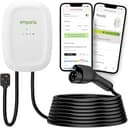
Emporia Level 2 EV Charger

Emporia Level 2 EV Charger

The most charger for the money right now: 48A output and a genuinely useful app at a price that undercuts the premium names. If you have (or can get) a 60A circuit, this is the one that turns the extra amps into the lowest cost per kW installed.

Best overall value
$449.00 · View on Amazon

Price as of September 2, 2026. #ad How we’re funded

2
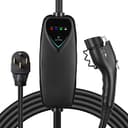
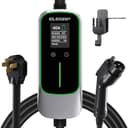
ELEGRP Level 2 EV Charger (40A, NEMA 14-50)

ELEGRP Level 2 EV Charger (40A, NEMA 14-50)

The cheapest way we found to get a genuinely ETL-certified 40A charger with a long cable. It is a plain plug-in unit with no app and no frills, which is exactly why it undercuts the name brands — buy it if the budget is the binding constraint and you already have a 14-50 outlet.

Cheapest certified 40A
$209.99 · View on Amazon

Price as of September 2, 2026. #ad How we’re funded

3
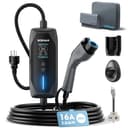
Lectron 40A Portable Level 1/2 Charger

Lectron 40A Portable Level 1/2 Charger

The best all-round portable: a real 40A / 9.6 kW Level 2 charger on a NEMA 14-50 plug, with a Level 1 adapter for a standard outlet. For many people this is all the home charger they need, and it comes with you on trips.

Best dual-purpose
$269.99 · View on Amazon

Price as of September 2, 2026. #ad How we’re funded

4
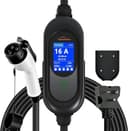
bokman Portable Level 1 & 2 Charger (16A)

bokman Portable Level 1 & 2 Charger (16A)

The dual-voltage answer at a Level 1 price: it runs from a standard 5-15 household outlet or a 6-20 240V outlet, which roughly doubles the charging rate wherever a 240V receptacle exists. That flexibility is what a travel charger is actually for.

Best dual-voltage
$99.99 · View on Amazon

$114.9913% off

Price as of September 2, 2026. #ad How we’re funded

5
TopAutoGear Portable Level 1 & 2 Charger (16A)

TopAutoGear Portable Level 1 & 2 Charger (16A)

The cheapest charger on this site, and it earns the slot by publishing two things budget listings usually leave blank: an IP54 rating and a five-year warranty. 16A is slow by design, so treat it as the unit that lives in the trunk for the day you need it rather than the one you plan your charging around.

Cheapest way to start
$119.89 · View on Amazon

Price as of September 2, 2026. #ad How we’re funded

The picks in full

#1Best overall value

Emporia Level 2 EV Charger

The most charger for the money right now: 48A output and a genuinely useful app at a price that undercuts the premium names. If you have (or can get) a 60A circuit, this is the one that turns the extra amps into the lowest cost per kW installed.

Strengths

  • 48A / 11.5 kW on a 60A circuit — near the top of home output
  • Load management and scheduling in the app, at a budget price
  • Plug-in or hardwired, NEMA 4 outdoor-rated

Trade-offs

  • 48A requires a 60A circuit, which not every panel has room for
  • Newer brand than ChargePoint or Wallbox, with a shorter track record
ConnectorJ1772
Max output48 A
Max power11.5 kW
Cable length25 ft
InstallPlug-in (NEMA 14-50), convertible to hardwired
Outdoor ratingNEMA 4 (outdoor)
Warranty3 years

Spec note. Ships on a NEMA 14-50 plug, which limits it to 40A; to pull the full 48A an electrician hardwires it on a 60A breaker. Pairs with Emporia's energy monitor for whole-home load management. Emporia now markets this unit as the Emporia Classic on its own store; the Amazon listing still uses the original name.

Specs read from the product listing, on August 26, 2026. “Not published” means the manufacturer does not state that figure.

#2Cheapest certified 40A

ELEGRP Level 2 EV Charger (40A, NEMA 14-50)

The cheapest way we found to get a genuinely ETL-certified 40A charger with a long cable. It is a plain plug-in unit with no app and no frills, which is exactly why it undercuts the name brands — buy it if the budget is the binding constraint and you already have a 14-50 outlet.

Strengths

  • ETL certified at 40A — the safety listing is the one thing you should never cut
  • 25 ft cable is longer than several units costing considerably more
  • Plugs into a NEMA 14-50 outlet, so there is no electrician bill for the charger itself

Trade-offs

  • No app, no scheduling — if you need off-peak automation, look at the Emporia
  • ELEGRP is a fixtures brand rather than an EV specialist; long-term support is the open question
  • The listing does not publish an outdoor enclosure rating, so treat it as a garage unit
ConnectorJ1772
Max output40 A
Max power9.6 kW
Cable length25 ft
InstallPlug-in (NEMA 14-50)
Outdoor ratingNot published
WarrantyNot published

Spec note. The listing publishes 40A, 240V, an ETL certification, a NEMA 14-50 plug and a 25 ft cable. It does not publish a NEMA/IP enclosure rating or a warranty term, so both read as not published here. A 40A charger requires a 50A circuit under the 80% rule.

Specs read from the product listing, on August 11, 2026. “Not published” means the manufacturer does not state that figure.

#3Best dual-purpose

Lectron 40A Portable Level 1/2 Charger

The best all-round portable: a real 40A / 9.6 kW Level 2 charger on a NEMA 14-50 plug, with a Level 1 adapter for a standard outlet. For many people this is all the home charger they need, and it comes with you on trips.

Strengths

  • True 40A Level 2 on a 14-50 outlet — same overnight speed as a wall unit
  • Includes a 120V adapter to fall back to any standard outlet
  • Packs in the trunk for road trips and destination charging

Trade-offs

  • Needs a 14-50 outlet installed to hit full speed at home
  • No wall bracket or scheduling — it's a cable, not a smart charger
ConnectorJ1772
Max output40 A
Max power9.6 kW
Cable length21 ft
InstallPlug-in (NEMA 14-50 + 5-15 adapter)
Outdoor ratingIP66 connector
Warranty1 year

Spec note. Adjustable amperage on some units lets you dial it down for a weaker outlet. On a standard 120V outlet it drops to Level 1 speed (a few miles of range per hour), which is the physics of the outlet, not the charger.

Specs read from the product listing, on July 19, 2026. “Not published” means the manufacturer does not state that figure.

#4Best dual-voltage

bokman Portable Level 1 & 2 Charger (16A)

The dual-voltage answer at a Level 1 price: it runs from a standard 5-15 household outlet or a 6-20 240V outlet, which roughly doubles the charging rate wherever a 240V receptacle exists. That flexibility is what a travel charger is actually for.

Strengths

  • Ships with both NEMA 5-15 (120V) and NEMA 6-20 (240V) plugs — one unit covers both
  • 16A rating is the practical maximum for this class of portable charger
  • 20 ft cable is longer than most units at this price

Trade-offs

  • The listing does not name a safety-certification body, unlike the Lectron
  • 16A is still a top-up rate, not a replacement for a Level 2 wall charger
  • Small brand with limited support history
ConnectorJ1772
Max output16 A
Max powerNot published
Cable length20 ft
InstallPlug-in (NEMA 6-20 or 5-15)
Outdoor ratingNot published
WarrantyNot published

Spec note. The listing publishes 16A, a 20 ft cable and both NEMA 6-20P and 5-15 plug options for Level 1 and Level 2 use. It does not publish a certification body, a kW figure or a warranty term.

Specs read from the product listing, on August 11, 2026. “Not published” means the manufacturer does not state that figure.

#5Cheapest way to start

TopAutoGear Portable Level 1 & 2 Charger (16A)

The cheapest charger on this site, and it earns the slot by publishing two things budget listings usually leave blank: an IP54 rating and a five-year warranty. 16A is slow by design, so treat it as the unit that lives in the trunk for the day you need it rather than the one you plan your charging around.

Strengths

  • Rated 110V-240V rather than 120V only, so it is not locked to Level 1 speed
  • Publishes an IP54 rating and a five-year warranty, which most listings at this price do not
  • LCD display shows what the unit is actually drawing

Trade-offs

  • 17 ft of cable is short next to the 25 ft several rivals publish
  • The listing names no safety-certification body — no UL or ETL file is stated
  • The listing does not publish which NEMA plugs are in the box
ConnectorJ1772
Max output16 A
Max powerNot published
Cable length17 ft
InstallPlug-in (110-240V)
Outdoor ratingIP54
Warranty5 years

Spec note. The listing publishes 16A across a 110-240V range, a 17 ft cable, an IP54 rating and a five-year warranty. It does not publish a kW figure, a certification body or the plug types supplied. At 16A the arithmetic is roughly 1.9 kW on a 120V outlet — about 3-5 miles of range per hour — and roughly 3.8 kW where a 240V outlet is available.

Specs read from the product listing, on August 22, 2026. “Not published” means the manufacturer does not state that figure.

How to spend the least without regretting it

The honest version of this advice is that the charger is usually the smallerhalf of your bill. A dedicated 240V circuit, a breaker, conduit, and the permit and inspection your jurisdiction requires routinely cost more than the box on the wall — and that number swings enormously with how far your garage is from the panel. If your budget is genuinely tight, the biggest saving available to you is almost never a cheaper charger. It is choosing an amperage your existing panel can feed without an upgrade.

That is why the Emporiaheads this list rather than the cheapest unit on it. It is a NEMA 4 outdoor-rated charger from an established brand that ships on a NEMA 14-50 plug at 40A — the cheap install — and can be converted to a hardwired 48A setup later if it turns out you need it. Starting cheap without closing the door on an upgrade is the most budget-friendly property a charger can have. Our full Emporia review goes deeper.

The one corner you must not cut

Skip any charger that will not state its certification body in plain text. UL and ETL listings both mean an independent lab tested the thing; a listing that says only “certified”, “CE” or nothing at all means nobody you can name has checked it. The EPA’s ENERGY STAR program keeps a public list of certified EV chargers, and cross-checking a model against it takes about thirty seconds. On a device that draws its full rated current continuously for hours in an unattended garage, that is the cheapest insurance available.

Where budget chargers legitimately save you money

No app.Scheduling to off-peak rates is genuinely useful if your utility has time-of-use pricing — but many cars do the same scheduling from the vehicle’s own screen, for free. If your EV can schedule charging itself, a charger app is a duplicate feature, and a unit like the ELEGRP that simply delivers power is not a compromise at this price point.

No energy monitoring. Nice to have, rarely acted on. Our cost-to-charge guideworks the same numbers from your electricity rate and your car’s efficiency with a calculator, which is all most people wanted the graph for.

Plastic instead of metal.Fine indoors. If the charger is going on an exterior wall, spend up for a real outdoor rating instead — our outdoor charger roundup covers what the NEMA numbers actually mean.

Where they do not

Cable length and flexibility.This is the most under-rated spec in the category. A 16 ft cable sounds generous until you account for the run down the wall, across the floor and around to a charge port on the opposite side of the car. Measure the actual path before you buy, and add slack. Budget cables are also stiffer, and stiffness gets dramatically worse below freezing — a cheap cable in a cold garage can be genuinely hard to coil.

The outlet, if you are plugging in. If your install uses a NEMA 14-50 receptacle, do not put a $10 hardware-store outlet behind a 40A continuous load. This is one of the more common causes of heat damage in home EV installs, and an industrial-grade receptacle costs very little more. Our NEMA 14-50 outlet guide shows exactly what separates them.

Plug-in or hardwired on a budget

Plug-in almost always wins when money is tight. A NEMA 14-50 receptacle is a standard part an electrician fits quickly, the charger comes with you if you move, and a failed charger is a five-minute swap rather than a service call. The catch is that a plug caps you at 40A — which, for the record, is still roughly 30 miles of range per hour, or over 300 miles across an overnight charge. Hardwiring buys you 48A and removes the receptacle as a failure point, but it costs more and ties the unit to the house. The full trade-off is in our plug-in vs hardwired guide.

A note on the three portable units here

The Lectron 40A portable, the bokman and the TopAutoGearare on a home-charger list deliberately. A 40A portable that plugs into a NEMA 14-50 does exactly what a wall-mounted 40A charger does — it just is not bolted down, and it packs in the trunk when you travel. For a renter, or for anyone who wants one device to cover home and away, that is better value than a fixed box. The bokman and the TopAutoGear are the other extreme: low-amperage units that charge from an ordinary household outlet, which is not a real home-charging solution for most people but is a legitimate way to start driving electric tomorrow with zero electrical work — and the bokman’s second plug doubles the rate wherever a 240V outlet exists. Our portable charger roundup and Level 1 roundup cover the category properly.

What we would skip entirely

Skip anything with no named certification body. Skip “80A” home chargers — no residential panel in a normal house feeds that, and the number is marketing. Skip units that will not publish a cable length. And skip paying for 48A or 50A if your panel cannot support a 60A circuit; you will have bought headroom you have physically disconnected. Our amps and circuits guide walks the 80% rule and the breaker sizes in full.
Frequently asked questions

Is a cheap EV charger safe?

A cheap charger from a real manufacturer with a UL or ETL listing is safe. A cheap charger with no named certification body is a genuine risk — this is a device drawing its full rated current continuously for hours, unattended. Certification is the one specification you should never trade away for price. Everything else on a budget charger is a convenience feature.

How many amps do I need on a budget?

40A is the value sweet spot. It adds roughly 30 miles of range per hour, which is over 300 miles across an overnight charge, and it runs on a 50A circuit that most panels can accommodate. Stepping to 48A requires a 60A circuit and often a panel upgrade — that upgrade will cost far more than any charger on this list.

Do I need the app?

Probably not. The main thing an app buys you is scheduling to off-peak electricity rates, and most modern EVs can schedule charging from the car's own screen for free. If your car can do it, a charger app is a duplicate. If your utility has no time-of-use pricing, it is not even that.

Can I install a budget charger myself?

You can hang a plug-in unit on the wall and plug it in yourself. The 240V circuit and the outlet behind it must be installed by a licensed electrician to code, and hardwired units are always an electrician's job. Nothing on this site is electrical advice.

Is a portable charger a real substitute for a wall charger?

For a 40A portable on a NEMA 14-50 outlet, functionally yes — it delivers the same power as a wall-mounted 40A unit and travels with you. The trade-offs are that it is not permanently mounted, the connector needs somewhere to live, and the plug becomes a wear point if you unplug it often.

Sources

Keep reading