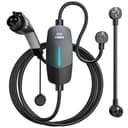
What the Leaf actually draws, and what it ignores
A wall charger does not charge the battery. It supplies 240V AC, and the onboard charger inside the car converts it to DC. That onboard unit is a hard ceiling: a bigger box on the wall cannot push past it. On the Leaf the ceiling is published, so the whole decision is visible in one table. The last two columns are what the car accepts, not what the charger offers. Circuit sizes use the same 80% continuous-load rule as our amps and circuits guide.
| Charger | Circuit | Supplies | 2025 Leaf | 2026 Leaf |
|---|
| 16A | 20A | 3.8 kW | 3.8 kW | 3.8 kW |
| 24A | 30A | 5.8 kW | 5.8 kW | 5.8 kW |
| 32A | 40A | 7.7 kW | ~6.0 kW | 7.2 kW |
| 40A | 50A | 9.6 kW | ~6.0 kW | 7.2 kW |
| 48A | 60A | 11.5 kW | ~6.0 kW | 7.2 kW |
Read the bottom three rows across and the argument is done. From 32 amps upward the car, not the charger, is the constraint, so the only thing a 40A or 48A unit adds on a Leaf is a larger breaker, thicker wire and a bigger invoice. The one honest exception is price: if a certified 40A charger happens to cost less than a 32A one on the day you buy, take it and run it on the circuit you already have. You are not buying the extra amps, you are buying the cheaper certified box.
Nissan’s own charging estimates land where the table says they should. For the 2025 Leaf it publishes about 11.5 hours on 240V for a full charge, alongside 40 kWh and 60 kWh battery options rated at 149 and 212 miles. For the 2026 car, with its 75 kWh pack and 303, 288 and 259 miles of range depending on trim, the 240V figure in Nissan’s spec table is still listed as TBD. The arithmetic is not hard to do in the meantime: 75 kWh at 7.2 kW is a little over ten hours before charging losses, and a 32A charger is already feeding it faster than it can accept.
The 2026 Leaf has two ports, and only one of them charges it at home
This is the single most expensive mistake available to a new Leaf owner right now. The 2026 car genuinely has a NACS socket — the same connector shape Tesla uses, standardized as SAE J3400— and Nissan markets it exactly as what it is: access to Tesla’s Supercharger network. It is the fast charge port. The port Nissan names for home and Level 2 public charging is the J1772 socket on the other fender.
For this purchase, then, a 2026 Leaf is a J1772 car, no different from a 2013 one. Every native-NACS wall charger we recommend elsewhere on this site — including everything on our NACS home charger roundup— is the wrong buy for this garage unless you add an adapter to it. The question to take into a store is never “does my car have a NACS port?” but “which port does my car use for Level 2 AC charging?” The owner’s manual charging section answers it in one line.
One neat consequence of that J1772 socket: on the 2026 car it is also how you get power back out. Nissan lists 1,500 watts of vehicle-to-load capability as standard, noting it “requires adapter for exterior J1772 port,” with a dedicated cargo-area outlet on the PLATINUM+ trim.
If there is already a Tesla charger on the wall
Mixed households are the common version of this problem: a Tesla in one bay, a Leaf in the other, and a NACS wall unit already installed. A NACS-to-J1772 adapter is the cheap fix, and it is the sixth pick on this page for that reason — roughly the price of a tank of gas against several hundred dollars for a second charger and circuit. Two honest caveats come with it. Tesla’s own Gen 3 Wall Connector manual states that no adapters or conversion adapters are allowed to be used, and its charging warranty excludes damage from non-genuine accessories, so that is Tesla’s stated position to weigh rather than ours to dismiss. And some Wall Connectors are configured to reject vehicles they do not recognize regardless of the adapter fitted. Our Tesla-to-J1772 adapter roundup covers the alternatives in full.
Check the trunk before you buy anything
Nissan lists a portable charge cable (120V / 240V EVSE) as standard equipment on both the 2025 and the 2026 Leaf. If yours is still in its bag, you may already own a dual-voltage cord, and what you are shopping for is convenience and speed rather than the ability to charge at all. Nissan does not publish that cable’s amperage in the spec table, so read the label on your own unit before spending: a 240V-capable travel cord plugged into a real outlet can carry a modest daily commute on its own, and a bought charger only earns its price once the daily miles outrun it.
That is also the honest case for Level 1 on the cheapest Leaf. The US Department of Energy’s Alternative Fuels Data Center puts Level 1 at about 5 miles of range per hour of charging at 1.9 kW, and Level 2 at about 25 miles per hour across a 2.9 to 19.2 kW band. Twelve hours on a household socket is therefore around 60 miles — comfortably more than the average US commute, and a real answer for a 40 kWh Leaf that mostly does short trips. Our Level 1 charger roundup is the page for that route. A 75 kWh 2026 Leaf that gets driven hard is a different story, and wants the 240V circuit.
Older Leafs: the DC side is why the home side matters more
Every Leaf before the 2026 car fast-charges on CHAdeMO, which the AFDC describes as a DC fast connector common among Japanese automakers and which is being phased out of the public network as it ages. The 2026 Leaf’s Supercharger access does nothing for those cars. That changes nothing about which charger to buy — the AC side is J1772 either way, and the onboard ceiling is no higher — but it does change how much rides on the garage. On an older Leaf, home charging is close to the whole plan, which is an argument for a proper 240V circuit and a cable long enough to reach, not for a bigger charger.
The install route, and the dryer-outlet shortcut
A 32A charger wants a 40A circuit; a 24A charger wants a 30A one. Because a Leaf cannot draw more than about 30 amps in the first place, that second option is genuinely interesting here in a way it is not for a long-range EV. A 24A charger on an existing 30A circuit supplies about 5.8 kW — within roughly a fifth of what the car can take — which for many households is the difference between an electrician’s quote and no electrician at all. Three of the picks on this page adjust down to fit: the EVPOVO steps through 16, 20, 24 and 32A, and the Grizzl-E Classic Connect covers 16 to 40A. Our NEMA adapter guide covers the plug-shape side of that, including the 14-30 dryer configuration and the current limits each adapter publishes. Have an electrician confirm the circuit, the wire and the breaker before you count on it.
The other half of the install question is GFCI protection. Per the installer network Qmerit, NEC 210.8(A) requires GFCI protection on 125–250V garage receptacles and NEC 625.54 requires it on receptacles installed for EV charging, while a charger’s own ground-fault detection can overlap with that breaker and trip a perfectly good session. Hardwired chargers are not subject to the 625.54 receptacle rule, which is the strongest argument for the Leviton on this list. If a plug-in charger keeps tripping a GFCI breaker, call the electrician — never remove the protection, whatever a product listing tells you.
Cable reach, because the socket is at the front
Nissan puts the 2026 car’s J1772 socket on the driver’s-side fender, and earlier Leafs also carry their charge port toward the front of the car rather than on a rear corner. That matters more than it sounds: the cable has to reach the nose of the car as it is actually parked, which for a nose-out driveway can mean running the full length of the vehicle. Measure it before you choose, and treat published cable lengths as approximate — EPA’s ENERGY STAR records show the Grizzl-E Classic’s cord at 24 ft against a 25 ft marketing figure. Four of the picks here publish 25 ft; the Leviton’s 18 ft is the one to check against your own garage.
What we left out, and why
- Every 48A charger on the site. The Emporia Level 2 is our overall pick for the site as a whole and it is a good charger. On a Leaf its extra 16 amps are unreachable, and its 60A circuit is a real cost. That comparison is worth reading only if your next car is bigger.
- Native NACS chargers. Correct for a Tesla, wrong for every Leaf ever sold in the US, including the 2026 car with a NACS port on its fender.
- The Enphase IQ 40. Also a 32A hardwired unit, with a NEMA 4 enclosure, a 25 ft cable and a five-year warranty — the longest in the class. We left it off on price for this audience, and it is the pick to revisit if you run an Enphase solar system and want charging to follow it. It is ranked in full on our 32A roundup.
- Cheap 40A plug-in units. The ELEGRP and EVIQO 40A chargers are certified and inexpensive, and we recommend them elsewhere. They are not wrong on a Leaf, they are simply not aimed at it: you would be buying amps the car cannot use, and on the day we checked the cheapest 32A pick here undercut both.
Which should you buy?
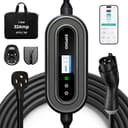
Already have a 240V outlet, or can get one cheaply? Buy the Battery Tender eCharge 32. It is certified under its own model number in EPA’s ENERGY STAR dataset, its 32A output matches the Leaf exactly, and the 120V adapter in the box means it doubles as the travel cord. Stock was thin when we checked, at four units with more on the way, so if the listing is out, the value pick below does the same job.
Want the cheapest way to full speed? Buy the EVPOVO 32A, understanding what you are accepting: the safety listing is the seller’s claim rather than an EPA record, and its model prefix is not among the certified families, so a rebate that requires ENERGY STAR will not take it.
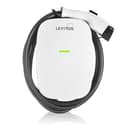
Hardwiring anyway, or fighting a GFCI breaker? Buy the Leviton EV320 and check the 18 ft cable against your parking spot first.
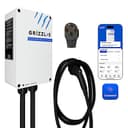
Is the Leaf a stepping stone? Buy the Grizzl-E Classic Connect, run it at 24 or 32A for the Leaf, and let it step up to 40A the day a bigger car and a bigger circuit arrive.
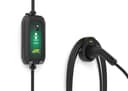
Renting, or not ready to spend? The EVDANCE Level 1 & 2 cord costs a fraction of a wall unit and, on a 40 kWh Leaf doing ordinary miles, may be all the charger you ever buy.