The table Tesla publishes and the listings do not
Here is the most useful thing about this product, and it is buried in a PDF. The Mobile Connector is not a 32 amp charger in the way a wall unit is a 48 amp charger. It is a cable whose current is dictated by the adapter on its end, and Tesla publishes the rate for every one of them:
| Outlet | Volts | Amps | Tesla’s rate | What it is |
|---|
| NEMA 14-50 | 240V | 32A | 7.6 kW | The fast case — a dedicated 50A circuit |
| NEMA 6-50 | 240V | 32A | 7.6 kW | Welder outlet; same rate as the 14-50 |
| NEMA 14-30 | 240V | 24A | 5.7 kW | Dryer outlet, derated by Tesla |
| NEMA 10-30 | 240V | 24A | 5.7 kW | Older dryer outlet, no separate ground |
| NEMA 6-20 | 240V | 16A | 3.8 kW | Small 240V circuit |
| NEMA 6-15 | 240V | 12A | 2.8 kW | Rare in homes |
| NEMA 5-20 | 120V | 16A | 1.7 kW | A 20A household circuit |
| NEMA 5-15 | 120V | 12A | 1.3 kW | The ordinary wall socket — Level 1 |
Three conclusions fall straight out of that table, and they are the whole buying decision.
The difference between the best and worst case is a factor of nearly six. 7.6 kW on a 14-50 against 1.3 kW on an ordinary wall socket. Same cable, same car, different plug. Anyone who buys this expecting “Level 2” and plugs it into a garage socket is going to be disappointed, and it will not be the cable’s fault.
Tesla derates the dryer outlets itself.On a NEMA 14-30 or 10-30 the manual publishes 24 amps and 5.7 kW, not 32 and 7.6. That is the correct behavior on a 30 amp circuit and it is one of the few places in this market where a manufacturer does the derating for you rather than leaving you a dial and a warning label. Our dryer-outlet guide covers what that means in practice, and the NEMA adapter page covers the third-party cords that do not derate themselves.
A 6-50 is as good as a 14-50 here.Both give the full 32 amps. If your garage has a welder outlet, you already have the fast case and do not need a new circuit.
What else Tesla publishes
Read from the Gen 3 owner’s manual, which is a better document than most of this category gets:
- Input:100–240 volt AC single phase. One cable for both Level 1 and Level 2 — the dual-voltage design, not a 120V unit with a trick.
- Cable:20 ft (6 m) with the adapter installed. Longer than several desk-bound portables and the figure that decides whether it reaches your port.
- Enclosure:Type 4X. That is a sealed, corrosion-resistant rating, which is unusual on a portable and the single most under-appreciated spec on the product — it is why this one survives living in a trunk.
- Weight:5.2 lb (2.4 kg). Light for what it is.
- Operating range:−22 °F to +122 °F, and ventilation is not required.
- Outlet requirements(Gen 2 manual, same family): a dedicated, properly grounded circuit rated for at least 15 A, with the outlet sited within about 13 ft (4 m) of the charge port and at least 18 in (45 cm) above the ground.
That last line is worth acting on. “Dedicated circuit” means nothing else on the breaker — not the freezer, not the garage lights. The most common cause of a portable charger tripping a breaker overnight is a shared circuit, not a faulty cable, which is the first thing our troubleshooting guide checks.
The box-contents problem, and why it is the whole price gap
Neither Amazon listing in this family has ever itemized the box. The feature text describes the charging, the NACS plug and the 20 ft cable, and never once says which NEMA adapters ship with it. On a product whose charging speed is defined by the adapter, that is the single most important missing fact.
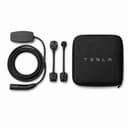
What we can check is Tesla’s own definition: Tesla describes its Mobile Connector Bundle as the connector plus a NEMA 5-15 adapter, a NEMA 14-50 adapter and a storage bag. If the listing you are buying says Bundle, that is the published composition of a bundle — a 120V adapter and the 240V one you actually want.
There is a second trap under the first. Tesla sells NEMA adapters by Mobile Connector generation— its own seven-piece set (5-20, 6-15, 6-20, 10-30, 14-30, 14-50 and 6-50) is published for the Gen 2 unit — and the retail listing does not state which generation it is shipping. If your plan is to buy the cable now and adapters later, confirm the generation with the seller first, or you will own a set that does not fit.
The ENERGY STAR record, which is a real reason to prefer the bundle
EPA’s ENERGY STAR certified-EVSE dataset carries a Tesla portable record: model 1937825-XX-X, a Level 1 / Level 2 dual-input unit at 32 A and 7.68 kW, qualified in March 2024, with the product feature “Model is portable.”
That matters for one specific reason: rebates. A number of utility programs will accept an ENERGY STAR certified portable unit where they would not accept an uncertified one, and a rebate can be worth more than the entire price difference between this and a cheaper cable. The bundle listing publishes part number 1937825-00-C, which matches that record. The bare listing published a different part number that matched neither Tesla row — one more reason the bundle is the listing to buy even before availability settled the question for us.
Confirm your exact model number with your own program before filing; these lists are maintained per model and we are not going to promise you a payment. Our certification and standards guide explains what each mark on a charger actually covers.
Price, honestly: you are paying for the badge and the paperwork
We do not print prices into our pages — the figure on the card above comes from a live daily check, so it is current rather than whatever was true when this was written. But the shape of the market is stable enough to describe, and it is unflattering.
Tesla’s cordset sits at the top of the portable field on price while sitting in the middle on capability. Several third-party portables in our registry deliver 40 amps rather than 32 — a real difference of roughly a fifth more power per hour — for substantially less money, and the cheapest credible dual-voltage units cost a small fraction of it. Our portable charger roundup is the full field with live prices, and best budget chargers covers the floor of what we would actually plug in.
So what does the premium buy? Four things, and whether they are worth it is genuinely personal:
- A factory NACS handle. No adapter hanging off the end, nothing extra to lose. For a Tesla owner that is a daily-use convenience, not a spec-sheet point.
- A Type 4X enclosure. Sealed and corrosion-resistant, on a device that lives in a trunk and gets used in weather.
- Tesla’s own documentation. You know the rate on every outlet before you buy, which is more than most of this category will tell you.
- An ENERGY STAR record. Potentially worth real money in rebate programs.
And one thing it is explicitly not: a replacement for a wall charger. If the car sleeps in the same garage every night, a fixed Level 2 unit is faster, tidier and frequently cheaper than this cable. We argue that at length in Wall Connector vs Mobile Connector, which is the page to read if you are choosing between them rather than buying this as a spare.
Why this is a purchase at all
Worth remembering that it did not used to be. Tesla stopped including a Mobile Connector with new cars for orders placed from 17 April 2022, with the reasoning given at the time that usage was low and the cable was not needed by owners who had a Wall Connector or used Superchargers.
That is the reason this page exists: a part that arrived in the trunk for free became a decision. And it changed the honest answer, because once you are spending money rather than unboxing a freebie, the third-party field is a legitimate comparison rather than an afterthought.
Who should buy it, and who should not
Buy it ifyou drive a Tesla or another NACS-port car and want a factory-matched spare in the trunk; if your household charges mostly at a wall unit and this is the travel kit rather than the daily driver; if a rebate program in your area accepts the ENERGY STAR record; or if you have a 14-50 or 6-50 outlet and want the simplest possible 7.6 kW setup with no installation at all.
Buy something else ifyou need the fastest portable you can get — 40 amp units exist and this is not one; if you drive a J1772 car, because you would be adding an adapter to a cable that costs more than the alternatives already; if your only outlet is an ordinary wall socket, because 1.3 kW is 1.3 kW whatever badge is on the brick, and a far cheaper Level 1 cable does the same job; or if the car parks in the same spot every night, in which case a wall charger is the better purchase.
One more scenario worth naming, because it is common and nobody writes it down: if you are buying this to leave at a second home or a relative’s house, the Type 4X enclosure and the 20 ft cable make it a better choice than its price suggests. A cable that lives outdoors in a carport for years is doing a job cheaper plastic does badly, and the road-trip kit page covers what else belongs in that bag.
If the premium is what you are weighing, Tesla Mobile Connector alternatives puts this cordset in one table with five portables that do the same job — two with a factory NACS handle, three cheaper J1772 units plus an adapter.