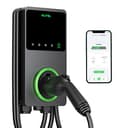
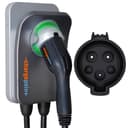
The specifications, side by side
Every figure here is the manufacturer’s own published number. The ChargePoint column describes the NEMA 14-50 plug-in model, because that is the Home Flex variant currently sold on Amazon — see the note below the table, because this matters more than it sounds like it should.
| Specification | Autel MaxiCharger AC Elite Home | ChargePoint Home Flex (14-50 plug) |
|---|
| Maximum output | 50A / “Maximum 12 kW (240 VAC @ 50 A model)” | “Up to 40A of power (30 miles of range per hour)” |
| Adjustable range | 16–50A in the app | 32A or 40A, set by the circuit |
| Circuit needed at full output | 70A — Autel’s own figure | 40A or 50A |
| Install | Hardwired at this output; plug-in versions are separate 40A models | Plug-in, NEMA 14-50 |
| Connector | SAE J1772 | J1772 (ChargePoint also sells NACS versions) |
| Cable | “25 ft. (7.5 m)” | 23 ft (7010.4 mm) |
| Enclosure | “IP65 / NEMA 4X” | “Type 3R per UL 50E” |
| Operating temperature | “-40 to 131 °F (-40 to 55 °C)” | -30 °C to 50 °C (-22 °F to 122 °F) |
| Certifications | CSA, ENERGY STAR | UL and cUL to UL 2594 / UL 2231-1 / UL 2231-2, NEC Article 625, ENERGY STAR |
| Connectivity | “Bluetooth, Wi-Fi, Ethernet, CAN, RS485” | Wi-Fi, with the ChargePoint network account |
| Load management | Lists “Adaptive Load Management (ALM); Dynamic Load Balancing (DLB)”; the required sensor hardware is not published | Not published for the Home Flex |
| Warranty | 3 years | 3 years, with 24/7 support |
The ChargePoint model split, which trips up a lot of buyers
The Home Flex has a reputation built on a feature the version most people can buy no longer has. ChargePoint’s own home-charging page splits it into three models: the hardwiredHome Flex, which “works with circuits rated from 20 to 80A” and “delivers up to 50A of power”, and the NEMA 6-50 and NEMA 14-50 plugmodels, which both “work with circuits rated 40 or 50A” and both deliver “up to 40A of power”.
The famous 16-to-50-amp dial — the thing that made the Home Flex the charger every electrician recommended, because you could put it on whatever circuit the panel could spare — belongs to the hardwired model. And the hardwired model is not currently listed on Amazon; the variant that is live, and the one the card above links, is the 14-50 plug at up to 40 amps. If you have read a three-year-old review praising the Home Flex’s flexibility, that review was about a different box than the one you can add to a cart today.
This is not a knock on the plug-in unit, which is a good charger. It is a correction to the reason people buy it. Buy the plug-in Home Flex because it is a polished 40-amp charger with the most mature app in the category that plugs into an outlet you already have — not because of a dial it does not have.
What a 70-amp circuit actually means
Autel publishes it plainly on its own store listing, and almost nobody repeats it: full 50-amp output requires a 70-amp circuit.
The arithmetic is standard and the result is unintuitive. EV charging is a continuous load, so the circuit is sized at 125% of the draw: 50 A × 1.25 = 62.5 A, and the next standard breaker above 62.5 is 70 A. Nearly every buyer reading “50 amps” mentally files it next to the 60-amp circuit that a 48-amp charger needs, and it is a size up from that.
On a 200-amp service with a modern panel, a 70-amp circuit is usually available. On a 100- or 125-amp service it frequently is not, and chasing it turns a half-day installation into a load calculation, possibly a panel change and possibly a service upgrade — the single largest line item in home EV charging. Our installation-cost guide has the ranges, and our 100-amp panel roundup is the page to read if that is your house.
The good news is that you do not have to buy the Autel at 50 amps. Autel publishes the output as adjustable from 16 A to 50 A in the app, so a 40-amp setting on a 50-amp circuit is a legitimate configuration — and that is the one we would choose for most houses. It gets you the IP65 / NEMA 4X shell, the -40 °F rating and the 25 ft cable at the same real-world charging speed as the ChargePoint, usually for less money. Our 40A versus 48A comparisonexplains why the amps above 40 are invisible to most cars anyway: the ceiling is the car’s onboard charger, not the wall box.
Hardwired versus plug-in, which is the real fork in the road
Because the Autel is hardwired at this output and the live ChargePoint is plug-in, this comparison is partly a proxy for the install question, and it is worth separating the two arguments.
The case for the plug-in ChargePointis immediacy and portability. If a 14-50 receptacle is already there — very common in garages wired for a dryer, a welder or an RV — the charger arrives, plugs in and works, with no electrician and no permit for the charger itself. It also unplugs and moves with you, which matters if you rent; see chargers for renters.
The case for hardwiring the Autelis that the receptacle is the weakest part of a plug-in install. NEC 210.8(A) requires GFCI protection for 125- to 250-volt garage receptacles and NEC 625.54 requires it for receptacles installed for EV charging; a charger’s own ground-fault detection can conflict with an external GFCI breaker, which is the nuisance-tripping complaint you will find in every owner forum. Hardwired chargers are not subject to the 625.54 receptacle requirement at all. A 14-50 receptacle also carries 40 amps continuously for hours every night, and a cheap one is a known failure point — if you are going plug-in, do not economize there (see NEMA 14-50 outlets). The full argument is in our plug-in versus hardwired guide.
The apps, and what each company is really selling
These two companies are in slightly different businesses, and it shows in the software.
ChargePoint runs a public charging network, and the Home Flex is the home end of a single account: the same app that starts your garage session finds and pays for public charging, tracks cost and handles scheduling, with 24/7 support behind it. If you use public charging regularly, having one account and one history for both is a genuine convenience that no spec row captures. Our public charging guide covers how those networks work.
Autel comes from automotive diagnostics and sells hardware, and the AC Elite is specified like a piece of equipment: Bluetooth, Wi-Fi, Ethernet, CAN and RS485 on the connectivity line, a holster built into the body, and ALM and DLB listed as features. Ethernet on a home charger is unusual and genuinely useful if the garage Wi-Fi is weak — a wired charger does not drop its schedule.
One honest gap on the Autel side. Autel lists Adaptive Load Management and says it “shares power between loads in the home, so you can charge and do your laundry at the same time”, but neither its store listing nor its product page states what sensor hardware ALM requires — a meter, CT clamps, or an installer-configured setting. Whole-home load management normally needs something watching the main feed, so we would treat ALM as a feature to confirm with Autel before you count on it to avoid a service upgrade. If load management is the reason you are shopping, the charger that ships the panel monitor in the box is the Emporia Pro, and our Autel versus Emporia comparison is that matchup directly. The load-management guide explains what the feature can and cannot do for a small panel.
Where each one genuinely wins
Buy the Autel MaxiCharger if
- You are hiring an electrician regardless, so hardwiring costs you nothing extra.
- The charger lives outdoors or in a hard climate. IP65 / NEMA 4X and a published -40 °F to 131 °F range are the best figures of any charger we have registered — see our cold-weather roundup.
- You want the cheaper unit, which it was when we checked, with the longer cable.
- You have a 200-amp service with room for a 70-amp circuit and a car that can actually use 50 amps — a short list that mostly means a large-battery truck or SUV.
Buy the ChargePoint Home Flex if
- There is already a NEMA 14-50 outlet where the car parks. This is the big one: it turns a project into a purchase.
- You use public charging and want one app and one account for home and away.
- You want the fuller certification list. ChargePoint publishes UL and cUL listing to UL 2594, UL 2231-1 and UL 2231-2 with NEC Article 625 compliance; Autel publishes CSA and ENERGY STAR. Both are legitimate — see our certification guide for what each mark covers.
- You rent, or expect to move, and want the charger to come with you.
The short answer
Both are good chargers and the choice is almost never about the chargers. Look at the wall first. An existing 14-50 outlet points at the plug-in ChargePoint and saves you an electrician. No outlet, and an electrician in the picture either way, points at the Autel — which we would have installed at 40 amps on a 50-amp circuit unless someone has confirmed a 70-amp feed is available and your car can use it.
And do not buy either one for amperage you cannot use. The number that caps your charging speed is your car’s onboard charger, which on most EVs sold in the US is between 7.2 and 11.5 kW — why a bigger charger changes nothing walks through it with published figures.
One buying note. Both brands sell direct as well as on Amazon and the prices are not always the same — Autel’s own store was running the AC Elite below the Amazon price when we checked for this page. We earn a commission on the links here and nothing on the direct ones, and we would still rather you paid less. Check both.