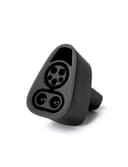
What UL 2252 is, and why it is the whole review
UL 2252 is the safety standard for EV coupler adapters— written for this exact class of product rather than borrowed from a general electrical category. A listing that cites it is claiming the part has been assessed against requirements specific to what it does: the thermal behavior of the contacts under sustained high current, the integrity of the housing, the interlock and grounding behavior, and what happens when things go wrong.
A listing that cites nothing is not necessarily unsafe. But it is asking you to take it on trust, on a part where the failure mode is a high-current arc in your hand. The premium over an uncertified alternative is small in absolute terms. We think it is the easiest money in EV charging to spend, and our certification guide explains what the various marks mean and how to check one is real rather than claimed.
How to verify the claim
Do not take our word for it either. Before ordering:
- Look for the mark on the product photos, not just the description text. A certification mark is molded or printed on the housing.
- Check the wording.“Tested to UL 2252” and “certified by [named laboratory]” are different claims. The second is stronger.
- Be suspicious of standard numbers used loosely. A general electrical certification is not the same as one written for coupler adapters.
Before you buy: can your Tesla actually use CCS?
The most expensive mistake in this category is buying the adapter before confirming the car supports the thing it enables.
CCS charging on a Tesla is not universal. Support depends on the vehicle’s hardware and, on some cars, a retrofit that Tesla supplies. If your car does not support CCS, an adapter is an ornament — the session will not start, and the adapter is not the reason.
Check with Tesla for your specific vehicle and model year before ordering. This is a five-minute step that avoids a hundred-dollar mistake, and it is the same discipline we apply on the other direction of this category, where non-Tesla owners routinely buy adapters before confirming account enrollment.
What the listing publishes, and what it does not
Published: a 500V rating and a UL 2252 reference for DC fast charging into NACS vehicles. The voltage figure comfortably covers the CCS stations a Tesla will realistically encounter.
Not published:a peak kW figure, a peak amp figure, or a warranty term. Our spec table prints “Not published” for each rather than guessing.
The missing power figures matter less than they appear to, because the adapter is not what sets your charging speedin any case. That is decided by the station’s capability, your car’s acceptance rate, the state of charge you arrive at and the battery’s temperature. A published kW number on an adapter is closer to marketing than to a specification you can use. Our adapter charging-speed guide explains where the time actually goes.
The missing warranty term is a genuine gap on a part at this price point, and we would rather say so than skip past it. Treat the retailer’s return window as your practical recourse.
Why you would want this at all
A fair question for a Tesla owner, given the Supercharger network exists. Three real answers:
- Coverage where Superchargers are thin. Rural routes, some regions, and corridors where the CCS build-out went first.
- Redundancy when a Supercharger site is full or down. On a trip with a schedule, having a second network available is worth the price of the adapter the first time you use it.
- Specific high-power CCS sites that may suit your journey better than the nearest Supercharger.
If none of those describe your driving, you may not need this. Our public charging guidecovers what to set up before a trip — network accounts and apps, which are free — and that is worth doing whether or not you buy an adapter.
Using it safely
The same discipline applies to any DC adapter, and on this part it is worth following properly:
- Seat it fully before starting the session. A partial connection under high current is how contacts get damaged. Push it home, then start.
- Never remove it under load. Stop the session at the station or in the car first. Adapters with an electronic interlock enforce this; without one, you are the interlock.
- Support the weight.The adapter plus the station’s cable is a lot of mass hanging on your charge port. Take the weight while seating, and rest the assembly rather than letting it dangle for the session.
- Inspect the contacts periodically.Discoloration, pitting or a burnt smell means heat, and heat means a bad connection. Retire it immediately — this is not a part to nurse along.
- Keep it clean and dry between uses. Grit in a DC contact is a genuine problem, not a cosmetic one. A case in the trunk is the right home for it.
The verdict
The one we would buy, and the reasoning is a single line: it is the only unit in this category whose listing names a standard written for the job. Everything else — the price gap, the missing kW figure, the unpublished warranty — is secondary to that on a part carrying this much current.
Confirm your car supports CCS charging before you order, verify the certification mark on the listing photos, and treat it as safety equipment rather than an accessory. If you want to see how it sits against the rest of the field, our CCS-to-Tesla roundup has the full ranking with the same criteria applied.