Amp & Adapter

Lectron J1772-to-Tesla Adapter Review

The single most useful $40 a Tesla owner can spend — what the 80A rating really means, and the one thing this adapter cannot do.

By Stephen V.Last updated How we rank

If you drive a Tesla and own one accessory, it should be this one. A J1772-to-NACS adapter is a small metal-and-plastic part that costs less than a tank of gas, and it converts your car from “can charge at Tesla stations” to “can charge at essentially every AC station in North America”. There is no other purchase in EV charging with that leverage-to-cost ratio.

The reason is structural. J1772 is the AC connector standard that every non-Tesla EV in North America has used for over a decade, which means it is what almost all public Level 2 charging, workplace charging, hotel charging and apartment charging uses. Your Tesla has a NACS port. The adapter bridges the two, and because it is an ACconnection the electrical work involved is genuinely simple — there is no communication protocol to translate, just a pin remap and a proximity signal. Our connectors guide explains why that simplicity matters.

This review covers Lectron’s version, which is the one we recommend in our J1772-to-Tesla roundup. Everything below is read from the published listing on the date shown under the pick. We own no units and run no bench tests; figures the listing does not publish read “Not published” rather than being guessed at.

How this is funded: we earn a commission if you buy through our links, at no extra cost to you. It never changes which product we recommend, and we’ll tell you plainly when we’d skip one. Full disclosure.

Quick picks

Ranked on published specs, install flexibility and buyer fit. Select a row to jump to the full write-up. We have not bench-tested these units — here is exactly what we do instead.

#ProductBest forPrice
1
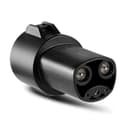
Lectron J1772 to Tesla Adapter

Lectron J1772 to Tesla Adapter

The adapter every Tesla owner should keep in the frunk: it lets a Tesla (or any NACS car) charge from the millions of public and home J1772 stations. Cheap, compact, and the single most useful $40 a Tesla owner can spend.

Our pick — best J1772-to-Tesla adapter
$39.99 · View on Amazon

Price as of September 2, 2026. #ad How we’re funded

The picks in full

#1Our pick — best J1772-to-Tesla adapter

Lectron J1772 to Tesla Adapter

The adapter every Tesla owner should keep in the frunk: it lets a Tesla (or any NACS car) charge from the millions of public and home J1772 stations. Cheap, compact, and the single most useful $40 a Tesla owner can spend.

Strengths

  • Opens up every J1772 Level 2 station to a NACS car
  • Rated for full 48A / Level 2 AC charging
  • Small enough to live in the glovebox

Trade-offs

  • AC charging only — this is not a Supercharger or DC-fast adapter
  • Locking behavior varies by station; some public units grip it loosely
ConnectorJ1772 → NACS (Tesla)
Max output48 A
Max power11.5 kW
Cable lengthNot published
InstallPlug-on adapter
Outdoor ratingNot published
Warranty1 year

Spec note. For AC (Level 2) charging only. It does not enable DC fast charging and is unrelated to the NACS-to-CCS DC adapters non-Tesla cars use at Superchargers.

Specs read from the product listing, on July 19, 2026. “Not published” means the manufacturer does not state that figure.

What the 80A rating actually means

The listing publishes 80A at 240V, and that number gets misread constantly. It is not a promise that your car will charge at 80 amps. It is a statement about the adapter’sceiling — the current it is rated to pass without heating.

What you will actually draw is the lowest of three numbers: the station’s output, the circuit behind it, and your car’s onboard AC charger. In practice that last one usually wins. Most EVs cap AC charging somewhere between 32A and 48A, and public J1772 stations very commonly deliver 32A. So an 80A rating means the adapter has substantial headroom over anything you will meet — which is exactly what you want on a part carrying current through two mechanical connections.

Headroom is the right thing to pay for here. An adapter running near its limit runs warm, and heat over years is what degrades contacts. An adapter rated far above your actual draw simply does not care.

The one thing it cannot do

It will not let anything DC fast charge. This is the most common and most expensive misunderstanding in the adapter category, so it is worth stating flatly: a J1772-to-Tesla adapter is an AC-only part. It does not work at a CCS fast charger. It does not turn a non-Tesla into a Supercharger customer. It does not help at any DC station of any kind.

The reason is not a limitation anyone chose. AC and DC charging are different electrical processes. On AC, the station passes household-style current to the car and the car’s own onboard chargerconverts it to DC for the battery — the connector is essentially passing power and a simple signal, so an adapter is a pin remap. On DC, the station itself does the conversion and negotiates a high-voltage, high-current session directly with the battery management system. That requires a fundamentally different, actively engineered part. Our AC vs DC guide covers this properly, and it is the single most useful thing to understand before buying any adapter.

If DC fast charging is what you want, you need a different product entirely. For a Tesla using CCS stations, that is a CCS-to-Tesla adapter. For a CCS car using Superchargers, it is a NACS-to-CCS adapter— and that one also requires your vehicle and account to be enabled, which our Supercharger access guide explains.

Where it earns its money

Public Level 2 charging. Shopping centers, parking lots, city curbside chargers, hotels. The overwhelming majority of these are J1772, and without an adapter a Tesla simply cannot use them.

Workplace charging. Employer-installed chargers are almost universally J1772 because they have to serve every brand in the parking lot.

Someone else’s home charger. Visiting family with an EV? Their charger is probably J1772.

Your own home charger, if you buy a J1772 unit. This is the strategic case, and it is worth thinking about before you buy a charger. A J1772 home charger plus this adapter costs about the same as a native NACS charger, but it charges any EV that ever visits or that you later buy. A native NACS charger charges Teslas and needs its own adapter for anything else. Our Tesla home charger roundup covers both routes, and the 40A roundup covers the J1772 units worth pairing with this adapter.

Living with it

Two practical notes that matter more than any specification.

Keep it in the car, not in the garage.The whole value of this adapter is that it works away from home, and an adapter in a drawer at home is worth nothing at a hotel. The glovebox is the right place, ideally in a case — the contact pins are the part that matters and loose grit is what degrades them. A hard case costs about ten dollars; see our Tesla charging accessories roundup.

Do not leave it hanging in the weather. An adapter left dangling from a station connector overnight collects water and dirt in the pins, and it is also how adapters get stolen or forgotten. Plug in, and take the adapter with you when you unplug.

What the listing does not publish

Worth naming: this listing publishes its amperage and voltage ratings and its compatibility, but not a warranty term or an ingress rating. On a part at this price that is not disqualifying — but if you are choosing between similar adapters, published documentation is a reasonable tiebreaker. The alternatives are covered in our J1772-to-Tesla roundup.

The reverse adapter is a different part

One more source of confusion. This adapter lets a NACS car use a J1772 station. The opposite part — letting a J1772 car use a Tesla Wall Connector or Destination Charger — is a Tesla-to-J1772 adapter, which is a physically different product. If you have a non-Tesla EV and want to use a Tesla home charger, see our Tesla-to-J1772 roundup instead.
Frequently asked questions

Will a J1772-to-Tesla adapter let me use a CCS fast charger?

No. This is an AC-only adapter and it does nothing at any DC station. AC and DC charging are different electrical processes — on AC the car's own onboard charger does the conversion, on DC the station does it and negotiates directly with the battery. A Tesla wanting CCS fast charging needs a CCS-to-Tesla adapter, which is a completely different product.

What does the 80A rating mean in practice?

It is the adapter's ceiling, not your charging speed. Your actual rate is the lowest of the station's output, the circuit behind it, and your car's onboard AC charger — and the car usually wins, capping somewhere between 32A and 48A. An 80A rating means the adapter has generous headroom over anything you will meet, which is what keeps it from running warm.

Do I need this adapter if I have a Tesla?

If you ever charge anywhere other than a Tesla station, yes. Almost all public Level 2, workplace and hotel charging in North America uses J1772, and without an adapter your car cannot plug into any of it. It is the highest-value accessory a Tesla owner can buy.

Can I leave the adapter attached to a public charger?

You can, but do not. An adapter left hanging collects water and grit in the contact pins, and it is easily stolen or forgotten. Take it with you when you unplug, and keep it in a case in the car rather than in a drawer at home — its whole value is that it travels.

Is this the same as a Tesla-to-J1772 adapter?

No, they are opposite parts. This one lets a NACS car (a Tesla) use a J1772 station. A Tesla-to-J1772 adapter lets a non-Tesla EV use a Tesla Wall Connector or Destination Charger. Buying the wrong direction is a common and frustrating mistake.

Sources

Keep reading