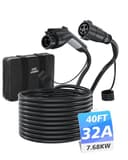
The short answer is no, and it is one of the few places on this site where we would give a flat answer rather than a trade-off. A household extension cord is the wrong tool for a Level 2 EV charger. There is a purpose-built product — a J1772 extension — that is acceptable in one specific situation, and there is a better fix that usually costs about the same. Both are below, after the part that explains why the obvious thing is a bad idea.
Why a household extension cord is the wrong tool
The problem is not voltage and it is not really length. It is duration.
Everything an extension cord is normally asked to do is intermittent: a drill for ninety seconds, a vacuum for ten minutes, a string of lights drawing almost nothing. A Level 2 EV charger draws 32, 40 or 48 amps continuously, for six to ten hours, every night, for years. Electrically that is a different category of load, which is why code sizes a continuous load at 125% of its draw: a 40A charger needs a 50A circuit precisely because the load never lets up.
Three things follow, and they compound:
- Every connection is a resistance, and resistance makes heat. A plug in a socket is a mechanical contact, not a weld. Add an extension and you have added two more of them to a circuit that is already running near its rating for hours at a time. Loose or corroded contacts get warm, warm contacts oxidise, oxidised contacts get warmer. That feedback loop is the documented failure mode in this category.
- Voltage drop shows up as heat in the cord.A long conductor at a light gauge loses voltage along its length, and the energy that goes missing does not vanish — it warms the cord. In a coiled cord on a garage floor, under a shelf, there is nowhere for that heat to go.
- Nothing is watching. Your charger has ground-fault protection and a communication pilot with the car. An extension cord has neither. It sits outside everything the system uses to notice that something is wrong.
There is also a practical point worth knowing: plug-in chargers already have a reputation for nuisance-tripping GFCI protection, because NEC 210.8(A) requires GFCI for 125- to 250-volt garage receptacles and NEC 625.54 requires it for receptacles installed for EV charging, and the charger’s own ground-fault protection can conflict with an external GFCI. Adding an extension into that chain makes an already-fussy arrangement worse.
The one product that is not an extension cord
A J1772 extension is a genuinely different thing, and the difference is which side of the charger it sits on.
A household cord goes between the wall and the charger — on the supplyside, carrying the full current through consumer-grade connections. A J1772 extension goes between the charger’s connector and the car — on the outputside, downstream of the charger’s own protection, inside the pilot-signal handshake, using the same connector standard the charger and car already speak.
That makes it acceptable in one situation, and only one:
- The charger is already mounted, and
- moving it is genuinely impractical — a rental, a shared wall, a unit installed in the wrong place by a previous owner — and
- you need another ten or fifteen feet, not another forty.
If all three are true, it is a cheap fix to an expensive problem and we would rather tell you it exists than watch you reach for a yellow cord from the garage.
What to look for if you buy one
Four checks, in this order.
- Amperage rating at or above your charger’s output.This is the one people get wrong. The extension’s rating becomes the ceiling for the whole assembly — a 32A extension on a 40A charger gives you a 32A setup. Check the number on the extension against the number on the charger, not against what your car can take.
- Length honesty. Buy the shortest one that solves the problem. Every extra foot is more voltage drop and more cable to coil.
- A real connector housing at both ends.The inlet end takes the weight of your charger’s connector hanging off it; the outlet end goes into the car.
- Where it will sit when it rains.An extension puts a connector joint somewhere other than the car’s port, often on the ground. Keep that joint off the floor and out of standing water.
The better answer, which usually costs the same
If you have not installed a charger yet, do not buy an extension at all. Buy a charger with a 25 ft cable, which is the longest length on the market and costs no more than a short one. That is the free version of this fix, and our long-cable roundup ranks the units that have it.
If the charger is already on the wall and 25 ft would have been enough, the right fix is usually to move the box rather than to lengthen the cable. A longer circuit run inside conduit is a one-time electrical cost with no ongoing failure points, where an extension is a pair of connections that get handled every day and live in the weather. Our installation cost guide covers what a longer run typically adds, and it is less than people expect.
And before you do either, measure the run properly: down the wall, along the floor, around the car to the side the port is on, up to the port, plus three feet of slack. Most people underestimate by ten to fifteen feet because they measure a straight line through the vehicle instead of a path around it. A surprising number of readers who think they need an extension actually need to mount the charger two feet to the left.
Level 1 charging, the one arguable case
At Level 1 the car draws around 12 amps from a standard household outlet rather than 40 from a dedicated circuit, so the margins are genuinely wider and the question stops being clear-cut. It is still not something we would recommend. The load is continuous and overnight, which is the part that does the damage, and a long thin cord on a cold garage floor is exactly where voltage drop turns into warmth.
If you are going to do it regardless: the shortest and heaviest-gauge outdoor-rated cord you can find, uncoiled completely so it can shed heat, nothing else on the circuit, and put your hand on the plug after an hour. Warm is a warning and hot is a stop. The real fix is an outlet closer to where the car parks, and our Level 1 roundup covers the chargers that go with it.
The short answer
No household extension cord, ever, on a Level 2 charger. A purpose-made J1772 extension is fine if the charger is already mounted and you need a modest amount of extra reach — buy one rated at or above your charger’s amperage, and the shortest one that works. If you have not bought a charger yet, buy a 25 ft one instead and the problem never arises.