Amp & Adapter

Can You Charge an EV With a Generator?

Yes, and the arithmetic is unforgiving. A 40-amp Level 2 charger asks for 9.6 kW continuous — bigger than most generators people own. A Level 1 cordset asks for 1.4 kW, which almost anything can manage.

By Stephen V.Last updated How we rank

How this is funded: we earn a commission if you buy through our links, at no extra cost to you. It never changes which product we recommend, and we’ll tell you plainly when we’d skip one. Full disclosure.

Yes — and then the arithmetic takes over. An EV charger does not know what is making the electricity, so any generator that supplies the right voltage and enough continuous current will charge a car. The problem is that “enough continuous current” for a 40-amp Level 2 charger is 9.6 kW, which is a bigger generator than almost anyone owns. For a Level 1 cordset it is about 1.4 kW, which almost any generator can manage. That gap is the whole guide.

Start from the charger, not from the car

People usually ask this question the wrong way round: “how big a generator do I need to charge my car?” The car has nothing to do with it. Your car’s battery size determines how long it takes; the charging equipment determines how much power is being drawn at any moment, and that is the number the generator has to meet.

The U.S. Department of Energy splits home charging into Level 1 at 120 volts and Level 2 at 240 volts. Multiply volts by amps and you have the draw:

  • Level 1, 12 A at 120 V = ~1.4 kW.A typical included cordset. Roughly 3–5 miles of range per hour.
  • Level 1/2 switchable, 16 A at 240 V = ~3.8 kW. The travel cordsets at picks two and three.
  • Level 2, 32 A at 240 V = ~7.7 kW.
  • Level 2, 40 A at 240 V = ~9.6 kW. The most common wall charger size.
  • Level 2, 48 A at 240 V = ~11.5 kW.

Now the part that catches people out. Charging is a continuousload — it runs flat out for hours, not in bursts. Generators are sold on a peak or “starting” watts figure and a lower running figure, and for charging you need the runningfigure comfortably above the charger’s draw, with headroom for everything else the generator is feeding. A 9.6-kW draw does not belong on a generator rated 10 kW running; it belongs on something substantially bigger, which in practice means a large standby or towable unit rather than the thing in your garage.

That is why the honest recommendation on this page is to charge at Level 1 from a generator and accept that it is slow. The same 125% continuous-load logic that governs breaker sizing in our amps and circuits guide is the reason.

Three things that stop a session even when the wattage is right

This is where generator charging actually fails, and none of the three is about having enough watts.

1. The neutral-to-ground bond

An EV charger is required to detect ground faults and it needs a proper neutral-to-ground reference to do so. Many portable generators run a floatingneutral — neutral is not bonded to the frame — because that is what makes them safe to connect to a house through a transfer switch. Plug a charger into a floating-neutral generator and the charger may simply refuse to start, reporting a ground fault, with no current ever flowing.

This is a real and common failure, it is a property of the generator rather than the charger, and the fix is a question for the generator’s own manual or a licensed electrician — not something to improvise with an adapter you read about online. We publish no generator specifications on this site because we have verified none; check what yourgenerator’s manufacturer says about neutral bonding before you buy any charging hardware for it.

2. The receptacle and the plug

A charger needs the outlet it was built for. A Level 1 cordset wants a standard 120-volt 5-15 receptacle, which every generator has. A Level 2 cordset wants 240 volts — usually a NEMA 14-50 or 6-50 — and only larger generators provide one. If your generator has a 240-volt twist-lock outlet rather than a 14-50, that is an adapter question, and our NEMA adapter guide and NEMA outlet types explainer cover what the numbers mean. Never improvise a 240-volt connection.

3. Power quality, and why the car is the fussy one

Your car’s onboard charger rectifies incoming AC and is reasonably tolerant, but the handshake that happens before any current flows is not. Charger and car exchange a pilot signal and confirm voltage, frequency and ground integrity first. An engine under a swinging load, or a small generator running near its limit, can wander enough to fail that check. The symptom is a session that will not start or keeps dropping out — which is a nuisance, not damage. The car protects itself; that is the whole point of the handshake, as our adapter safety guide explains in the adapter context.

So what should you actually do?

Three scenarios cover almost everyone who asks this question.

A power outage

Charge at Level 1 and leave the generator capacity for the refrigerator and the furnace fan. A 12-amp cordset overnight adds something like 30–50 miles of range, which is more than enough for local driving while the grid is down, and it is a load a modest generator carries without strain. Trying to run a 40-amp wall charger in an outage will generally either overload the generator or starve everything else in the house.

A cabin, a job site or anywhere with no grid

Level 1 again, or a switchable 16-amp cordset if the generator genuinely has a 240-volt outlet and the running watts to back it. Pick two is switchable for exactly this reason: 120 V where that is all there is, 240 V when there is more. Think of it as trickle-charging a car you are not driving every day rather than as a charging station.

Running out of charge on the road

Honestly: call for a tow or a mobile charging service. Carrying a generator to rescue an EV is heavy, slow and worse value than a tow in every case we can construct — at Level 1 you would be sitting there for hours for 20 miles. Planning the stop is the better tool; see road-trip charging kits.

What it costs, and why you should not do this to save money

Generator electricity is expensive electricity. A small engine turning fuel into watts is far less efficient than grid generation, and you pay retail pump prices for the fuel. Put that against the residential electricity price our cost-to-charge guideworks from — and against the gas comparison in EV charging cost vs gas— and generator charging lands well above both. In an outage that does not matter. As a habit it makes no sense at all.

There is also a wear argument. Charging is a long, steady, near-constant load, which is actually a kind thing to ask of a generator — far kinder than cycling a well pump — but it means hours of runtime per charge and the service intervals that come with it.

The safety rules we will not soften

  • Never run a generator indoors, in a garage, or near an open window. Carbon monoxide is the single biggest killer associated with generators, and an EV charging session runs for hours while everyone is asleep. Outside, well away from the house, always.
  • Never back-feed a dryer outlet or a receptacle to energize the house. If you want the generator to power house circuits, that is a transfer switch installed by an electrician. Our dryer-outlet guide covers the charging side of that family of outlets; the back-feeding question is not a DIY one.
  • Do not improvise 240-volt adapters. Use the plug configuration the charger and the generator were both built for, or an adapter rated for the current, and stop if anything gets warm.
  • Read your generator’s manual on neutral bonding before buying hardware. It is the most likely reason a session will not start, and it is specific to your unit.

The honest summary

Charging an EV from a generator works, and it is a genuinely useful thing to know how to do for an outage or an off-grid stay. It is also slow, expensive per mile, and much more likely to be stopped by a floating neutral than by a shortage of watts. Buy a Level 1 cordset, keep it with the generator, run the generator outdoors, and treat the whole arrangement as a way to keep driving locally rather than as a charging solution. For everything else, the wall and the grid win on every measure — which is what our home charger roundup is for.
Quick picks

Ranked on published specs, install flexibility and buyer fit. Select a row to jump to the full write-up. We have not bench-tested these units — here is exactly what we do instead.

#ProductBest forPrice
1
Lectron Level 1 EV Charger (15A, 110V)

Lectron Level 1 EV Charger (15A, 110V)

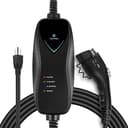
The one Level 1 charger we would actually recommend, because it is ETL certified and comes from a brand that specializes in EV charging. A Level 1 unit is a spare and a safety net, not a primary charger — buy it on that basis and it is a genuinely useful thing to own.

The sane generator pairing
$159.99 · View on Amazon

$179.9911% off

Price as of October 18, 2026. #ad How we’re funded

2
bokman Portable Level 1 & 2 Charger (16A)

bokman Portable Level 1 & 2 Charger (16A)

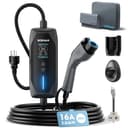
The dual-voltage answer at a Level 1 price: it runs from a standard 5-15 household outlet or a 6-20 240V outlet, which roughly doubles the charging rate wherever a 240V receptacle exists. That flexibility is what a travel charger is actually for.

Switchable, if the generator has 240 V
$114.99 · View on Amazon

Price as of October 18, 2026. #ad How we’re funded

3
Battery Tender eCharge 32 (Level 1 + 2)

Battery Tender eCharge 32 (Level 1 + 2)

A 32A plug-in charger from a long-established battery-charger brand, ENERGY STAR certified under its own model number, with a 120V adapter in the box so it doubles as a Level 1 travel cord. It has no app by design. You pay well over the budget 32A units for that paper trail and the 3-year warranty.

If the generator is genuinely large

The three cordsets, in full

#1The sane generator pairing

Lectron Level 1 EV Charger (15A, 110V)

The one Level 1 charger we would actually recommend, because it is ETL certified and comes from a brand that specializes in EV charging. A Level 1 unit is a spare and a safety net, not a primary charger — buy it on that basis and it is a genuinely useful thing to own.

Strengths

  • ETL certified — the single most important thing on a device left plugged in overnight
  • Plugs into any standard 110V household outlet, so it works anywhere
  • Includes a 16 ft extension cord alongside the J1772 cable

Trade-offs

  • Level 1 is slow — plan on topping up rather than a full charge overnight
  • Costs more than the no-name Level 1 units, which is the trade for the certification
  • 15A on a shared household circuit can trip a breaker if something else is on it
ConnectorJ1772
Max output15 A
Max powerNot published
Cable length16 ft
InstallPlug-in (standard 110V outlet)
Outdoor ratingNot published
WarrantyNot published

Spec note. The listing publishes 110V, 15A, ETL certification and a 16 ft extension cord with a J1772 cable. 110V at 15A works out to roughly 1.6 kW, but the listing does not publish a kW figure so the spec table leaves it blank rather than printing our arithmetic as a manufacturer spec.

Specs read from the product listing, on August 11, 2026. “Not published” means the manufacturer does not state that figure.

#2Switchable, if the generator has 240 V

bokman Portable Level 1 & 2 Charger (16A)

The dual-voltage answer at a Level 1 price: it runs from a standard 5-15 household outlet or a 6-20 240V outlet, which roughly doubles the charging rate wherever a 240V receptacle exists. That flexibility is what a travel charger is actually for.

Strengths

  • Ships with both NEMA 5-15 (120V) and NEMA 6-20 (240V) plugs — one unit covers both
  • 16A rating is the practical maximum for this class of portable charger
  • 20 ft cable is longer than most units at this price

Trade-offs

  • The listing does not name a safety-certification body, unlike the Lectron
  • 16A is still a top-up rate, not a replacement for a Level 2 wall charger
  • Small brand with limited support history
ConnectorJ1772
Max output16 A
Max powerNot published
Cable length20 ft
InstallPlug-in (NEMA 6-20 or 5-15)
Outdoor ratingNot published
WarrantyNot published

Spec note. The listing publishes 16A, a 20 ft cable and both NEMA 6-20P and 5-15 plug options for Level 1 and Level 2 use. It does not publish a certification body, a kW figure or a warranty term.

Specs read from the product listing, on August 11, 2026. “Not published” means the manufacturer does not state that figure.

#3If the generator is genuinely large

Battery Tender eCharge 32 (Level 1 + 2)

A 32A plug-in charger from a long-established battery-charger brand, ENERGY STAR certified under its own model number, with a 120V adapter in the box so it doubles as a Level 1 travel cord. It has no app by design. You pay well over the budget 32A units for that paper trail and the 3-year warranty.

Strengths

  • ENERGY STAR certified: EPA's dataset lists the 022-3017 family, and the maker publishes cETLus to UL 2594
  • Level 1 and Level 2 in one box: a NEMA 14-50 plug plus a 14-50R-to-5-15P adapter
  • 25 ft output cord, an IP66 rating and a 3-year warranty
  • No app to set up or fail; status and error messages show on an LCD

Trade-offs

  • Costs well over twice the cheapest 32A plug-in units
  • Plug-in, so a GFCI-protected garage receptacle can trip with it
  • No scheduling app, so off-peak timing has to come from the car
  • Amazon showed 'Only 4 left in stock (more on the way)' when we checked on 18 September 2026
ConnectorJ1772
Max output32 A
Max power7.7 kW
Cable length25 ft
InstallPlug-in (NEMA 14-50; 120V 5-15 adapter included)
Outdoor ratingIP66
Warranty3 years

Spec note. Battery Tender publishes: 32A Level 2 at about 7.7 kW (about 20-25 miles of range per hour), about 1.9 kW on 120V, a dedicated 240V 40 Amp circuit minimum, a 25 ft output cord, IP66, cETLus (UL 2594), ENERGY STAR, FCC and ICES, 6.37 lb, and a 3-year warranty. EPA's ENERGY STAR dataset lists the 022-3017-XX-XX family as a Level 1/Level 2 dual-input charger (qualified 2024-01-04, 25 ft cord). The maker's own store listed it above the Amazon price when we checked. A bundle with a Tesla adapter is sold as a separate listing.

Specs read from the product listing, on September 18, 2026. “Not published” means the manufacturer does not state that figure.

General guidance, not electrical advice. Amp & Adapter is written by an EV-charging enthusiast, not a licensed electrician. Circuit sizing, breakers and hardwired installs must be done by a qualified electrician to local code — the figures here are for planning a purchase, not a wiring job.

Frequently asked questions

Can you charge an electric car with a generator?

Yes. An EV charger does not know or care what is producing the electricity, so a generator that can supply the right voltage and enough continuous current will charge a car. The constraint is size: a Level 1 cordset draws about 1.4 kW, which a small generator handles, while a 40-amp Level 2 charger draws 9.6 kW continuous — more than most portable generators can sustain.

What size generator do I need to charge an EV?

Work from the charger, not the car. A 12-amp Level 1 cordset at 120 volts is about 1.4 kW, so a 2,000-watt generator covers it with headroom. A 16-amp Level 2 charger is 3.8 kW. A 32-amp Level 2 charger is 7.7 kW, and a 40-amp one is 9.6 kW — and because charging is a continuous load you want the generator's running (not peak) rating comfortably above that, which in practice means a large standby or towable unit.

Will charging from a generator damage my EV?

Charging itself will not: the car's onboard charger rectifies and conditions incoming AC, and it will refuse a connection it does not like rather than accept bad power. The failure mode is nuisance faults, not damage — the charger's ground-fault detection needs a properly bonded neutral-to-ground reference, and many portable generators float the neutral, which can stop a session before any current flows.

How many miles of range does a generator add per hour?

At Level 1 from a small generator, roughly 3 to 5 miles of range per hour — so an overnight run might add 30 to 50 miles. At 240 volts and 32 amps from a large generator, roughly 20 to 25 miles per hour. Either way it is slow, and the fuel cost per mile is substantially worse than grid electricity, which is why this is an emergency or off-grid tool rather than a charging strategy.

Can I charge an EV from a generator during a power outage?

Yes, and Level 1 is usually the right choice for it. A 120-volt cordset on a small generator will add enough range overnight to cover normal local driving, and it leaves generator capacity for the refrigerator and the furnace fan. Trying to run a 40-amp Level 2 charger off a portable generator during an outage will generally either overload it or starve everything else.

Is it cheaper to charge an EV with a generator than from the grid?

No, substantially not. Gasoline or propane burned in a small engine to make electricity is far less efficient than grid generation, and you pay retail fuel prices for the privilege. A generator is worth using when there is no grid — an outage, a remote cabin, a job site — not as a way to save money. Our cost-to-charge guide has the grid arithmetic for comparison.

Sources

Keep reading