The six, side by side
Every cell is read from the same registry entries as the reviews above. Read the weather-rating and warranty columns first: that is where the money went on the picks at the top of the cap, and what the cheaper units leave unpublished.
| Product | Connector | Max output | Max power | Cable | Install | Weather rating | Warranty | Price |
|---|
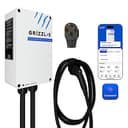
| Grizzl-E Classic Connect 40A (J1772) | J1772 | 40 A | 9.6 kW | 25 ft | Plug-in (NEMA 14-50) | UL Type 4 (indoor/outdoor) | 3 years | |
|---|
| Grizzl-E Classic Connect 40A (NACS) | NACS (Tesla) | 40 A | 9.6 kW | 25 ft | Plug-in (NEMA 14-50) | UL Type 4 (indoor/outdoor) | 3 years | |
|---|
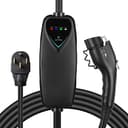
| Lectron 40A Portable Level 1/2 Charger | J1772 | 40 A | 9.6 kW | 21 ft | Plug-in (NEMA 14-50 + 5-15 adapter) | IP66 connector | 1 year | |
|---|
| EVPOVO Level 2 Wall Charger (40A, 25 ft) | J1772 | 40 A | 9.6 kW | 25 ft | Plug-in (NEMA 14-50) | Not published | Not published | |
|---|
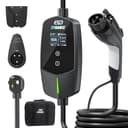
| EVDANCE 40A Portable Level 2 Charger | J1772 | 40 A | 9.6 kW | 25 ft | Plug-in (NEMA 14-50, adapters vary) | IP67 connector | 1 year | |
|---|
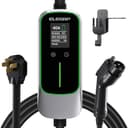
| ELEGRP Level 2 EV Charger (40A, NEMA 14-50) | J1772 | 40 A | 9.6 kW | 25 ft | Plug-in (NEMA 14-50) | Not published | Not published | |
|---|
The four criteria we used
1. A certification we can point at.Under $300 the market fills up with unbranded 40-amp boxes, and the single most important thing a cheap charger can publish is a safety listing — UL or ETL, which both mean a recognized lab tested the unit against the same standard. Every pick here either publishes one or is excluded; our certification guide explains what UL 2594 actually covers.
2. The full 40 amps.Forty amps on a 50-amp circuit is the ceiling for any charger that plugs into a NEMA 14-50 outlet, under the 80% continuous-load rule. Several sub-$300 units are 32 A or 16 A instead; those are real chargers with a real use, but if you are paying for an install we think you should get the full 40. The 16-amp travel units are covered in Level 1 and 2 portables.
3. Cable length, published. Cable is the specification cheap chargers quietly shorten, and it is the one you cannot fix later without an extension cable. Four of these six publish 25 feet; one publishes 21, and that is noted in its review.
4. What is not published.Two picks here state no enclosure rating and no warranty term at all. That is not a disqualification at this price — it is the trade — but it does decide where the unit should live, and we say so on each one.
How we ranked these six
The Grizzl-E Classic Connect is the best charger under $300 because it is built like a charger that costs twice as much. United Chargers publishes a cast-metal UL Type 4 indoor/outdoor enclosure, a 25-foot cable, a three-year warranty and 16–40 A adjustment set inside the unit — so if your panel can only spare a 30-amp circuit, the same charger still fits. It plugs into a NEMA 14-50, so it comes off the wall and moves house with you. Two honest cons: its ceiling is 40 A, so it is not the charger to buy if you want 48, and the Wi-Fi radio on the Connect generation is the newest and least proven part of a product line whose reputation was built on having nothing to fail. Full detail in the Classic Connect review.
The NACS version of the same charger is the Tesla pick. Identical box, identical 40 A, identical 25-foot cable and UL Type 4 shell, with a native Tesla-style handle instead of a J1772 head — so nothing dangles off the end of your cable and there is no adapter to lose or to leave in the rain. The con is the mirror image of the benefit: a NACS handle charges a J1772 car only with a second adapter, so if your household has one Tesla and one non-Tesla, buy the J1772 version and a J1772-to-Tesla adapter instead. Our Tesla charger roundup ranks the native-NACS field in full.
The Lectron 40A portable is the best dual-purpose pick.It is a 40-amp Level 1 and Level 2 unit: a NEMA 14-50 plug for the garage, a 5-15 adapter in the box for a standard household outlet, an IP66-rated connector and a 21-foot cable. Mount it on a bracket and it behaves like a wall charger; unclip it and it is the charger you keep in the trunk for a weekend at a rental. Two real cons: the one-year warranty is the shortest in this group, and at 21 feet the cable is the shortest too. The Lectron portable review has the figures, and travel-kit picks cover the adapters to pair with it.
The EVPOVO Level 2 40A is the long cable for less.It publishes a full 25-foot cable and 40 A on a NEMA 14-50 plug for appreciably less than the Grizzl-E, which makes it the obvious pick when the parking spot is at the far end of the garage and the budget is fixed. The small-brand caveats apply in full and we will not dress them up: the listing publishes no enclosure rating and no warranty term. We would mount it inside a garage, not on an exposed wall. Our EVPOVO review sets out exactly what it does and does not state.
The EVDANCE 40A portable is the cheapest route to a full 40 amps.It is the lowest-priced unit on this page that delivers the whole 9.6 kW, with a 25-foot cable and an IP67-rated connector — the highest connector ingress rating in this group — in a travel housing. Cons: a one-year warranty, and the plug adapters vary by bundle, so check which ones are included before you count on charging from anything other than a 14-50. The EVDANCE review has the detail, and EVDANCE alternatives compares it against the rest of the portable field.
The ELEGRP Level 2 40A is the budget pick. It is the cheapest route we have found to a genuinely ETL-certified 40-amp wallcharger with a 25-foot cable: a plain plug-in box with no app, no scheduling and nothing to configure. The certification is why it is on this page rather than the price. What the listing does not publish is an enclosure rating or a warranty term, so the same siting rule as the EVPOVO applies — under cover, not on an exposed wall. Figures in the ELEGRP review.
Wall unit or portable at this price?
Under $300 the two categories cost the same, so the decision is about how you live rather than what you get. Buy the wall unit if the car parks in the same place every night, you want the strongest enclosure and the longest warranty, and you would rather the charger looked like part of the house. Buy the portableif you rent, if you travel to places with a 14-50 or a dryer outlet, or if you want one charger to cover both. The honest summary is that a portable is a wall charger with a lighter housing, a shorter warranty and a handle — and at this price that is a fair trade rather than a downgrade. Our plug-in roundup and 40-amp portable roundup each take one side of that argument in full.
What $300 does not buy
Four things, and it is worth knowing before you shop. Forty-eight amps.That needs a hardwired charger on a 60-amp circuit and it starts above this cap — see 48A chargers and 40 vs 48 amps for whether it is worth the electrician. A mature app. Scheduling, energy reporting and utility rate integration live in the smart chargertier; under $300 you get a charger, and your car’s own app can usually schedule charging anyway. Load management.If your panel is full, the module that lets a charger share a circuit costs more than these chargers do — see chargers for a 100-amp panel. And the install.A NEMA 14-50 outlet fitted by an electrician usually costs more than any charger here; installation cost breaks that down, and it is the number that should shape your budget first.
One thing to ignore
Headline amperage above what your circuit or your car can take. A listing advertising “up to 48 A” on a 14-50 plug is quoting a number the plug cannot legally deliver, and plenty of EVs cap AC charging at 7.2 kW no matter what the wall supplies. Check the car’s onboard charger rating and your panel’s spare capacity first — our amps and circuits guideshows how — and then buy the cheapest certified charger that meets it. At this price that is usually the right answer.