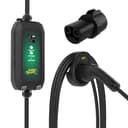
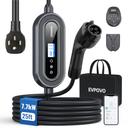
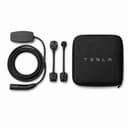
The four, side by side
Read from the same registry entries as the reviews above, so the table and the write-ups cannot drift apart. The column that decides most purchases here is the connector: three of these four end in a handle your car either accepts or does not, and buying the wrong one is a returns problem rather than an adapter problem.
| Product | Connector | Max output | Max power | Cable | Weather rating | Warranty | Price |
|---|
| Battery Tender eCharge 32 (Level 1 + 2) | J1772 | 32 A | 7.7 kW | 25 ft | IP66 | 3 years | |
|---|
| EVPOVO Level 2 32A (NEMA 14-50) | J1772 | 32 A | 7.7 kW | 25 ft | Not published | 3 years | |
|---|
| AIMILER Level 2 32A NACS (Wi-Fi) | NACS (Tesla) | 32 A | 7.7 kW | 25 ft | NEMA Type 4 / IP66 (per listing) | 3 years | |
|---|
| Tesla Mobile Connector Bundle (32A, NACS) | NACS (Tesla) | 32 A | 7.6 kW | 20 ft | Type 4X | 1 year (per the Amazon listing) | |
|---|
What a 40-amp circuit really gives you
A 32-amp charger is a 40-amp appliance, and that is the whole reason this class exists. Running a 40-amp circuit to a garage wall needs lighter conductors than a 50-amp run, costs less to install, and — the part that matters in an older house — is far more likely to fit inside the service capacity the panel already has without a load-management device or a service upgrade. Our amps and circuits guide works the arithmetic for every common circuit, and chargers for a 100-amp panel covers the case where capacity, not budget, is the constraint.
The practical consequence is that most of these chargers adjust downward, and that is a feature worth paying attention to. The EVPOVO publishes 16/20/24/32 A steps; the AIMILER publishes 16–32 A and maps them to breaker sizes on the listing itself (32 A for a 40-amp breaker, 24 A for 30, 16 A for 20). The Tesla Mobile Connector takes a different approach entirely: the NEMA adapter you fit sets the current, and Tesla’s own charging-rate table publishes 32 A / 7.6 kW on 14-50 and 6-50, 24 A / 5.7 kW on 14-30 and 10-30, and down to 12 A / 1.3 kW on a household 5-15. That is a cleaner design than a menu, because the hardware cannot be set wrong for the outlet.
Plug-in means GFCI, and GFCI means nuisance trips
Every charger on this page plugs in, and current code requires GFCI protection on the receptacles they plug into. Some combinations of charger and breaker trip for no fault at all — the charger has its own leakage detection (CCID20 on the EVPOVO, CCID-20 on the AIMILER) and the two protection schemes can argue. The answer is a different breaker or a hardwired charger, never removing the protection. If that is the situation you are in, our hardwired roundup is the honest exit, and why an EV charger stops charging covers diagnosis first.
How we ranked these four
The Battery Tender eCharge 32 leads on evidence rather than price.It is the one unit here whose certification we can check in somebody else’s database: EPA’s ENERGY STAR dataset lists the 022-3017 family as a Level 1 / Level 2 dual-input charger with a 25-foot cord, qualified in January 2024, and the manufacturer publishes cETLus to UL 2594, IP66, 6.37 lb and a three-year warranty. It ships with a 14-50R-to-5-15P adapter, so it is a Level 1 travel cord as well as a Level 2 home charger, and it has no app by design. Two honest cons: it costs well over twice the cheapest 32-amp units, and the only listing Amazon still carries is the Tesla-adapter bundle, so a J1772 driver pays for an adapter they may not need. Full detail is in the dual-voltage roundup.
The EVPOVO Level 2 32A is the budget pick and the cheapest 32 amps we will recommend.Its listing publishes 7.68 kW, a 25-foot TPU cable the seller rates flexible to −22 °F, 16/20/24/32 A adjustment from buttons or app, ETL listing to UL 2594 and UL 2231-1/-2, CCID20 leakage protection and a three-year warranty. What it does not have is third-party confirmation: its model number (a ZA11 prefix) is not among the families EPA certifies, so it will not satisfy a rebate that requires ENERGY STAR, and the listing publishes no numeric enclosure rating at all — only “weather-resistant”. That is the trade at this price, and it is a defensible one if the outlet is indoors.
The AIMILER 32A NACS is the pick for a car that AC-charges through a NACS port, because a native handle means nothing hangs off the connector. The listing publishes 32 A / 7.68 kW, a 25-foot cable, NEMA Type 4 / IP66, Wi-Fi app control and a three-year warranty. Two cautions. Its model number fits an ENERGY STAR-certified family registered under the Zopoise brand rather than AIMILER, so confirm eligibility before counting on a rebate. And it carries the GFCI line we flagged above, which is the one piece of advice on any of these listings we would tell you outright to ignore.
The Tesla Mobile Connector Bundle is the pick for a Tesla owner who wants Tesla’s own hardware.Tesla publishes 32 A “controlled by the appropriate adapter”, a 20-foot cable, Enclosure Type 4X, 5.2 lb and an operating range of −22 °F to +122 °F. It is the shortest cable here and the ceiling is 32 amps where a Wall Connector reaches 48 — no adapter changes that. The listing also does not itemise which NEMA adapters are in the box, which is worth confirming before you count on 240 V. Our Mobile Connector review and Mobile Connector alternatives cover both.
What to ignore in this category
A 32-amp charger sold as a substitute for a 48-amp wall unit.It is not one, and the gap is real: 7.7 kW against 11.5 kW. It is a substitute for a 40-amp circuit, which is a different and much better argument. Any listing that publishes amps without kilowatts, or an enclosure described only as weatherproof with no rating number — we have flagged the one page pick where that applies rather than hiding it. And any instruction to defeat a GFCI breaker. See above; it appears on a listing we still recommend, which is exactly why we say it twice.