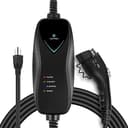
Yes — overnight, over a weekend, and over a month. And for the long cases it is not merely permitted, it is the better option: a plugged-in EV can draw what it needs to look after itself from the wall instead of from its own battery. The thing you should change before a long absence is not the plug, it is the charge limit.
What actually happens when the battery is full
The anxiety behind this question usually comes from phones and power tools, where “leaving it on the charger” meant something was still pushing. That is not how an EV works.
Charging is governed by the car, not the charger. The battery management system asks for current and the charging equipment supplies what is asked for; when the pack reaches the limit you have set, the car stops asking and the session ends. The charger goes idle with the cable still attached. There is no trickle being forced into a full pack, and no mechanism by which a stationary, finished session degrades anything.
What continues is small and useful. The car wakes periodically to run its own electronics, keep the 12-volt battery topped up, answer the app, and condition the traction pack if the temperature calls for it. Plugged in, that energy comes from the wall. Unplugged, it comes out of the traction battery — which is exactly what you were trying to protect.
Overnight, every night
Entirely fine, and the normal pattern that home charging was designed around. Lithium-ion packs are not damaged by frequent shallow top-ups, and there is no meaningful “cycle” consumed by adding 20% to a battery. Home Level 2 charging at 7 to 10 kW is also the gentlest charging a pack ever receives — a DC fast charger delivers ten times that.
The one habit worth adopting is the charge limit, not unplugging. On a nickel-based (NMC or NCA) pack, setting the daily limit around 80% keeps the pack out of the high-voltage band where calendar ageing accelerates, and costs you nothing if your daily mileage fits inside it. Charge to 100% when you actually need the range, and leave soon after. If your car has an LFP pack the guidance is usually the opposite and regular full charges are expected. Our battery health guide covers both chemistries properly, and the manual for your car is the authority.
A week, a month, a winter: the storage case
This is where leaving it plugged in goes from “harmless” to “recommended”, and it is worth being concrete about why.
A parked EV is not inert. It is answering an app, running telematics, keeping a 12-volt system alive and occasionally warming or cooling a battery. The drain is modest day to day and adds up over weeks. Left unplugged for a month, a car can lose a meaningful chunk of state of charge — and the genuinely bad outcome is a pack that drifts down toward empty and sits there, or a 12-volt battery that dies and leaves you unable to open the car normally.
Plugged in, none of that happens. The car maintains itself from the wall and holds the state of charge where you set it.
Three things to set before you walk away:
- A mid-range charge limit.Not 100%, not near-empty. Somewhere in the middle — commonly 50 to 60% for storage — is the kindest place for a nickel-based pack to sit for weeks, and your manual may give a specific figure for your car. This is the single most useful thing on this page.
- Sentry, guard and remote-monitoring modes off. They are the biggest avoidable parasitic draws, and they are of limited value in your own locked garage. On a plugged-in car this matters less, but it still means less needless cycling.
- A circuit you are happy leaving energized. Which brings us to the one real caveat below.
The case for a Level 1 cord while a car is stored
If the car is being stored rather than driven, a 120-volt cord is arguably the better tool than a Level 2 charger, and it is why pick one leads this page.
A Level 1 cord delivers roughly 1.4 kW. It cannot refill a battery quickly — but refilling is not the job. Holding a state of charge and covering a car’s standby draw needs a small fraction of that, and a low, undemanding load on an ordinary dedicated outlet is the least stressful arrangement for everything involved: no 50-amp circuit sitting energized for a month, no 40-amp receptacle under load, nothing working hard.
Two conditions. Use a dedicated, properly grounded outlet— Tesla’s own Mobile Connector manual specifies a wall outlet on a dedicated and properly grounded circuit rated for at least 15 amps — and no household extension cord in the chain. Our extension cord guide explains why that is a flat no even at Level 1 currents. Our Level 1 roundup covers the certified options.
When we would unplug instead
Four situations, stated plainly, because “always leave it plugged in” is too simple.
- Electrical storms, if your grid is rough. Rain is a non-event — see charging in the rain— but a nearby lightning strike can put a surge through the service. If storms where you live routinely trip breakers or kill appliances, unplugging during one is reasonable, and whole-house surge protection is a conversation with your electrician.
- Any equipment you have doubts about.A receptacle that runs warm, a cracked connector, a charger with no published enclosure rating sitting outside. Do not leave a marginal connection energized unattended for a month — fix it. Our slow-charging guide covers the heat check, and an industrial-grade NEMA 14-50 receptacle is the fix for a plug-in install that will be left connected.
- A shared or public space. Leaving a car on a shared Level 2 station for a week is a social problem rather than a technical one, and many networks charge idle fees for it.
- Nobody around and no way to check. If the car will be entirely unattended for months, it is worth having someone look at it occasionally regardless of what it is plugged into.
Two practical details people miss
The latch may hold the cable.Tesla’s owner’s manual explains that the charge cable latch stays locked until the car is unlocked or recognizes its key, to prevent unauthorized unplugging. That is a feature when the car sits plugged in for a week, and a confusion if a house-sitter tries to remove the handle without the key. Tell them.
The connector needs somewhere to live. If the car leaves and the cable stays, the connector should not spend a week on a wet garage floor collecting grit that then goes into your charge port. A holster is pick three and costs less than twenty dollars; our holster picks cover the field.
The short answer
Leave it plugged in. Overnight it stops on its own; over a month it looks after itself from the wall rather than from the battery. Set a daily limit around 80% on a nickel-based pack and a mid-range limit near 50 to 60% before a long absence, turn off the sentry and monitoring modes, use a Level 1 cord on a dedicated outlet if the car is being stored rather than driven, and dock the connector instead of dropping it. Unplug for a storm if your grid warrants it, and for any connection you are not confident in.