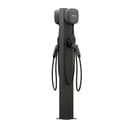
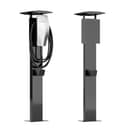
How we ranked these, in order
This category is full of listings that look identical because many of them substantially are. Four criteria separate them, and they are deliberately not the ones the listings lead with.
- Published fitment. Not the word “universal” — an actual hole pattern, thread size or named charger plate. Two pedestals here publish one: VIVO states an M4 thread base requirement, and Inteset publishes an M5 screw hole plus plates named for Wallbox Pulsar, Tesla Gen 3 and the Grizzl-E. Everything else asks you to measure and hope.
- Published weight capacity. Exactly one pedestal on this page publishes one (VIVO, 33 lb). That is a genuine data point, not a marketing number, and the table below gives you something to check it against.
- Published standing height. Two publish one. Several publish a carton dimension that reads like a height and is not — if a “17 x 10 x 7 in” figure appears on a 5 ft pedestal, you are looking at the box.
- Warranty term. Six months to three years across these six. On a steel post anchored outdoors, that spread tells you something about how much confidence each seller has in its own powder coating.
We own none of these and we do not claim to have installed one. Our methodology page explains what that means for every ranking on this site.
The fitment check nobody sets up for you
Here is the structural oddity of this category. Pedestal listings publish a weight capacity (sometimes). Charger documents publish a weight and a footprint (sometimes). Nobody puts the two side by side, so the buyer does the join — and usually skips it.
These are the published figures for chargers we cover, read from the manufacturer documents cited at the bottom of this page:
| Charger | Size | Weight | Note |
|---|
| Tesla Gen 3 Wall Connector | 13.6 x 6.1 x 4.3 in | 10 lb with wirebox | Hardwired only — Tesla's manual says not to use a cord-and-plug connection |
| Tesla Universal Wall Connector | 13.6 x 6.1 x 5.9 in | About 13 lb | Hardwired only; deeper than the standard unit because of the adapter dock |
| Leviton EV320 | Not published on the maker's page | Not published | Hardwired only, NEMA Type 3R |
| Wallbox Pulsar Plus | Not published for the pedestal fit | Not published | The one charger family with a manufacturer's own pedestal |
The useful conclusion from that table is a reassuring one: a 33 lb capacity is comfortable for the two chargers whose weights are actually published. Tesla’s Gen 3 Wall Connector is 10 lb with its wirebox and the Universal about 13 lb. The capacity figure becomes a real constraint only on the heavy end of the market — a long-cable 50A unit with a cast enclosure — and the honest position is that most chargers do not publish their weight at all, so if yours does not, weigh the box.
The second thing the table shows is that most of these chargers are hardwire-only. Tesla’s own Gen 3 manual says plainly: “Do NOT install cord-and-plug type connections.” That matters enormously for a pedestal, and it is the subject of the next section.
The pedestal is the cheapest part of a pedestal install
This is the sentence the listings will not write for you, so we will.
A wall install runs a circuit from the panel to a wall. A pedestal install runs a circuit from the panel to a point in the middle of open ground. In practice that means a trench, conduit rated for direct burial, a stub-up at the pedestal location, and either an existing concrete slab to anchor into or a new footing poured for the purpose. Every pedestal here ships anchor hardware for concrete and none of them ships concrete.
So the pedestal is a small line on that invoice. Our installation cost guide walks through what drives the rest of it, and the short version is: distance from the panel, and whether a trench is involved. A pedestal install usually involves both.
Two consequences worth planning around before you buy anything:
- Hardwired is usually the right call on a pedestal. It is what most of the chargers above require anyway, and it avoids the receptacle rule described below. Our hardwired versus NEMA 14-50 guide makes the general case; outdoors, in the open, on a post, it is stronger than usual.
- Position it for the cable, not for the look. A 20–25 ft cord from a wall has one job: reach the port. From a pedestal it has to reach the port and get there around a parked car. Work out where the charge port sits on the cars that will use the bay — and remember that a second car may park nose-in while the first parks nose-out.
The receptacle rule, and why it bites harder outdoors
If your installer puts a receptacle on the pedestal so a plug-in charger can live on it, the relevant code requirements follow the receptacle, not the charger. NEC 210.8(A) requires GFCI protection for 125- through 250-volt garage receptacles, and NEC 625.54 requires it for receptacles installed for EV charging — which is exactly what a pedestal receptacle is.
That is not a reason to be nervous; it is a reason to say “hardwired” when the electrician asks. A hardwired charger is not subject to the 625.54 receptacle requirement at all, and it also avoids the known overlap between a charger’s own internal ground-fault protection and an external GFCI breaker that causes nuisance trips. Our 32A roundup goes into that interaction in detail, because it is most common on smaller circuits.
Nothing on this site is electrical advice. The point of raising it here is that the decision — receptacle or hardwired — is cheapest to make before the trench is dug, and a pedestal is the install type where it is easiest to get wrong.
Height: what the published numbers actually give you
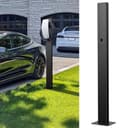
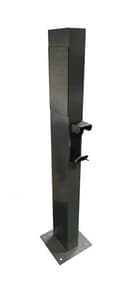
Where a standing height is published at all, these pedestals cluster between about 55 and 62 inches — Wallbox publishes 55 in for the Eiffel Basic, Inteset 60 in for its post, VIVO 61.7 in for its stand. That puts a charger body somewhere around chest height.
That is a sensible place for it, for two reasons that have nothing to do with ergonomics. First, it keeps the charger and its connector well clear of standing water and snow — Tesla’s own Mobile Connector documentation asks for the supply outlet to be at least 18 in above the ground, and a pedestal clears that by a wide margin. Second, it lets the cable hang in a loop rather than pooling on the floor, which is the single biggest cause of jacket damage over a charger’s life. A cable hook on the post finishes that job for a few dollars.
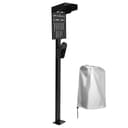
What a tall pedestal does not do is protect the charger from the weather. Only two picks here publish any overhead structure, and neither publishes a NEMA or IP rating for it.
Roofs, baffles and what they are really for
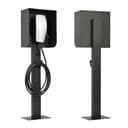
The “with roof” pedestals are the most common upgrade in this category and the most commonly misunderstood. A roof is not weatherproofing. Your charger’s own enclosure rating is the weatherproofing — that is what a NEMA 3R, NEMA 4 or IP65 rating means, and our outdoor charger roundup decodes those.
What a roof or a baffle does buy you is shade, and that is a real benefit for a reason no ingress rating covers: ultraviolet light. Sun degrades polymer housings and stiffens cable jackets over years, and no NEMA number has anything to say about it. Our covers and enclosures page makes that argument at length. A pedestal in the open, with no carport or overhang above it, is the most UV-exposed place you can put a charger — so overhead protection is worth more here than it is on a wall under an eave.
The honest ranking consequence: the pick with the best overhead protection on this page also has the shortest warranty on this page. Those are both true at once, and which matters more depends on whether your pedestal site has shade already.
What we left out, and why
Four things we found and did not feature, because this category needs the negative list more than most.
Relabeled clones. One listing we checked, under a different brand name entirely, carries the Maizengauto listing’s bullet text word for word — including the phrase “this Maizengauto EV charger pedestal” inside its own product description. We are not linking a product whose seller did not rewrite the copy it inherited. It also tells you what this category is: a small number of steel fabrications sold under many names.
Listings with garbled specifications. A cheap 59-inch pedestal looked promising until we read its feature text, which contains mangled fragments (“this [V charger stand”, “your FVcharger manufacturer’s instructions”). It publishes no warranty term and reported thin remaining stock on the day we checked. When the listing text has not been proofread, the specifications in it are not worth quoting.
Commercial pedestals above the top pick. Dual-port and cable-retractor pedestals exist well above everything here, including a retractable cable-management pedestal in four figures. They are built for fleet yards and workplace charging, and recommending one for a home driveway would be selling the reader the wrong product at the highest commission on the page.
Charger-brand pedestals with no live listing. Several charger manufacturers make their own pedestals; only one of them had a verified, in-stock Amazon listing when we checked. We list the one that did.
When not to buy any of these
Most people reading a page about charger pedestals have a wall. If you do, the honest recommendation is to spend a small fraction of a pedestal’s price on the two accessories that actually extend a charger’s life: a holster to keep the connector off the floor, and a hook to keep the cable off cold concrete. Together they cost less than the cheapest pedestal here and they prevent the failure that actually happens.
There is also a middle option this page cannot sell you, and should mention anyway: moving the charger. If the only problem is that the wall is on the wrong side of the garage, relocating the circuit at install time is often cheaper than a pedestal plus a trench, and it leaves you with a wall-mounted charger. Ask for both quotes.
Buy a pedestal when there is no wall, when the parking position is fixed and worth pouring concrete for, or when two cars need to share one post. Those are good reasons. “It looks more professional” is not one, at the price of a trench.