The six picks, side by side
Read from the same registry entries as the write-ups above. Most accessories publish very little — an italic “Not published” is an honest gap in the seller’s own listing, never something we filled in.
| Product | Connector | Max output | Cable | Warranty | Price |
|---|
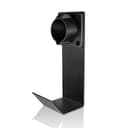
| Lectron J1772 Holster / Wall Dock | J1772 | Not published | Not published | Not published | |
|---|
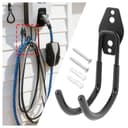
| VKQTS Heavy-Duty J-Hook Cable Holder | Not published | Not published | Not published | Not published | |
|---|
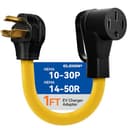
| ELEGRP NEMA 10-30P to 14-50R Adapter (1 ft) | NEMA 10-30P → NEMA 14-50R | 30 A | 1 ft | Not published | |
|---|
| LENZ Charger Lock for J1772-to-Tesla Adapter (2-pack) | Fits J1772-to-Tesla (NACS) adapters | Not published | Not published | Not published | |
|---|
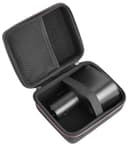
| Maoershan EVA Hard Case for CCS1 / J1772 Adapters | Not published | Not published | Not published | Not published | |
|---|
| PROHIKER Wall Charger Station Box | Not published | Not published | Not published | Not published | |
|---|
Problem 1: the connector on the floor
This is the one that costs real money if you ignore it. A J1772 or NACS connector head is a precision electrical interface, and the failure mode is boring: grit in the pins, water in the housing, a cracked shroud from being driven over. A holster mounts on the wall and the head lives in it. The Lectron dock is universal to the J1772 head and costs about twenty dollars; our holster roundup has the combination units that holster the head andhook the cable, including the MECMO combo if you would rather buy one part than two. Anchor into a stud — drywall anchors pull out under a heavy 25 ft cable.
Problem 2: the 240V outlet you already own
Most older houses have a 240-volt receptacle already — it is behind the dryer. The three-prong NEMA 10-30 in an older home, or the four-prong 14-30 in a newer one, cannot accept a charger built for a NEMA 14-50 plug, and a one-foot adapter fixes that for twenty dollars instead of an electrician’s visit for several hundred. The ELEGRP 10-30 adapter publishes the thing most competing adapters leave out: 10 AWG STW cable, with the gauge stated.
There is one condition and it is not optional: the circuit behind a 10-30 or 14-30 outlet is 30 amps, so you must dial the charger down to 24 A yourself. The adapter cannot do it and will not stop you getting it wrong. Older 10-30 receptacles also have no separate ground conductor, only a bonded neutral, so have an electrician confirm the outlet is sound before you charge from it nightly. Our NEMA adapter roundup covers the 14-30 and 6-50 versions, and charging from a dryer outlet works through the derating in full.
Problem 3: someone unplugging your car
If you drive a Tesla and charge at public J1772 stations, your adapter is the weak link — the car’s own latch holds the adapter, and the station connector clips to the adapter, which anyone can release. A locking ring snaps over that joint. The LENZ two-pack claims the broadest fit we could verify and, unusually, its listing states the condition every lock of this type depends on: the car must be locked with your phone or key out of range before anything engages. Treat fit on aftermarket adapters as unconfirmed — the pack note names Tesla’s own OEM adapter. The adapter lock roundup covers the alternatives and what each one actually protects.
Problem 4: the adapter in the glovebox
An adapter that lives loose in a car gets knocked around, and its contact pins are the interface for hundreds of amps on a DC unit. A rigid EVA case for fifteen dollars is a straightforwardly good trade. Read the listing carefully on any of these: the Maoershan is the case only, which it states and buyers routinely miss, and it fits one adapter — a two-adapter owner needs two cases. If what you need is a bag for a whole portable charger rather than a case for an adapter, the BLIRITEL cable bag on our cable organizer roundup is the cheaper answer.
Problem 5: sun and rain on an outside wall
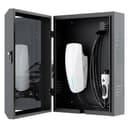
UV is what kills outdoor plastics, not rain, and a charger mounted on a south-facing wall takes years of it. Two routes: a soft cover for under twenty dollars, or a hard box. The PROHIKER enclosure is the sensible middle — a rigid, published waterproof and dustproof box with cable management at roughly a third of what the premium enclosures cost. Two honest limits: it publishes no lock, so treat it as weather protection rather than security, and it publishes no interior dimensions, so measure your charger first. Our cover and enclosure roundup has the locking boxes and the fabric covers at both ends of the price range, and outdoor-rated chargers is the page to read if the unit itself is not rated for where you want to put it.
What we would skip
Extension cords.Not an accessory — a hazard, for reasons of duration rather than voltage. If the cable will not reach, the answer is a charger with a longer cable or an outlet in a better place. The full argument is in can you use an extension cord, and the purpose-built J1772 extension cables that do exist are covered, with their caveats, on our charging cable roundup.
Anything promising faster charging.Covered above: no accessory can raise the lower of your car’s onboard limit and your circuit. Cheap NEMA 14-50 receptacles.If you are doing a plug-in install, the outlet is the one place not to save money — see the outlet roundup. Adapters that do not name their rating. A connector adapter carrying 48 amps continuously should publish its current rating, and plenty do not.